Technology Consulting: A Practical Guide for Decision-Makers
Technology Consulting: A Practical Guide for Decision-Makers

Technology consulting converts technology decisions into measurable business outcomes — revenue growth, cost reduction, and faster delivery. A cloud migration that cuts hosting costs by consolidating infrastructure, an AI-assisted lead scoring model that lifts conversion rates, or an automation layer that removes manual service delivery steps: these are the kinds of results a well-scoped engagement produces. Technology consulting provides guidance on technology choices and how to use IT, cybersecurity, and AI to improve business performance.
Hiring a technology consultant is worth it when:
- Your organization is facing a complex cloud migration or platform modernization with no internal expertise to lead it
- A capability gap is slowing product delivery or creating security exposure
- Speed-to-market pressure is real and your current team cannot close the gap alone
- A merger, acquisition, or market expansion requires rapid technology integration
- Repeated system outages or stalled initiatives signal that internal approaches have plateaued
Key Takeaways
Technology consulting delivers the most value when engagements are scoped to specific outcomes, governed by an internal champion, and measured against KPIs set before work begins.
| Point | Details |
|---|---|
| Hire when capability gaps are real | Engage a consultant when complexity, speed, or missing expertise would cost more to solve internally than externally. |
| Match firm type to problem type | Strategy firms for direction, large integrators for execution capacity, boutiques for specialized technical problems. |
| Set KPIs before the engagement starts | Define 3–5 measurable outcomes upfront; review at 30, 60, and 90 days post-implementation. |
| Pilot before scaling | BCG’s roughly 30% transformation success rate reflects scope failures; start with a contained pilot and expand on proven results. |
| Moderatemurmurations for small teams | Moderatemurmurations delivers AI-assisted websites, automation, and digital systems for small businesses without enterprise overhead. |
Table of Contents
- What does technology consulting actually cover?
- Core services and specializations you should know about
- How does technology consulting deliver measurable business value?
- What does a typical technology consulting engagement look like?
- When should you hire a technology consultant?
- How do you choose the right technology consulting firm?
- Which type of consulting firm fits your situation?
- A practical technology consulting path for small businesses
- What problems do McKinsey, Bain, BCG, EY, and IBM typically solve?
- Why AI and digital transformation now dominate consulting conversations
- How do you measure the success of a consulting engagement after it ends?
- The gap between what consulting promises and what actually gets delivered
- Moderatemurmurations helps small teams build and launch faster
- Sources
What does technology consulting actually cover?
Technology consulting, also called IT consulting or IT advisory, is the practice of helping organizations make better technology decisions and then execute on them. The formal scope runs from strategy through operations, and a skilled consultant ties every recommendation to a business objective rather than a technology preference.
Core scope areas include:
- Strategy and architecture: Defining which platforms, systems, and patterns best serve the organization’s goals over a 2–5 year horizon
- Implementation and delivery: Leading or supporting the build, migration, or integration work
- Operations and risk: Establishing governance, monitoring, and security controls after go-live
- Data and AI: Designing data pipelines, analytics capabilities, and AI-assisted workflows
- Capability transfer: Leaving internal teams with the knowledge and runbooks to operate independently
A technology consultant’s day-to-day responsibilities during an engagement typically include assessing the current state, producing recommendations with clear trade-offs, supporting delivery teams, and managing stakeholder communication.
What technology consulting is not: a one-off development contract with no strategic context. If a vendor is writing code without first understanding your business model, revenue drivers, and risk tolerance, that is staff augmentation, not consulting.
Core services and specializations you should know about
Most consulting firms organize their practices around a set of service lines. Knowing which line maps to your problem saves time during procurement.
- Cloud and platform transformation: Migrating workloads from on-premises infrastructure to AWS, Azure, or Google Cloud; reducing operational overhead and improving reliability. A typical use case is a mid-market company consolidating five legacy servers into a managed cloud environment to cut hosting costs and improve uptime.
- Data and analytics / AI: Building data warehouses, BI dashboards, and machine learning models. Use cases range from customer churn prediction to automated document processing.
- Cybersecurity and risk: Threat assessments, zero-trust architecture, compliance readiness (SOC 2, HIPAA, PCI-DSS), and incident response planning.
- Software delivery and integration: API design, microservices architecture, CI/CD pipeline setup, and connecting disparate SaaS tools so data flows without manual re-entry.
- Enterprise architecture: Designing the overall technology blueprint so individual systems fit together and support long-term growth.
- Digital experience: Customer-facing web and mobile platforms, conversion optimization, and personalization engines.
- Automation and hyper-automation: Robotic process automation (RPA), workflow orchestration, and AI-assisted task handling to reduce manual labor costs.
Specializations change who shows up on the engagement team. An AI project needs data scientists and ML engineers. A platform build needs solution architects and DevOps engineers. A cybersecurity assessment needs certified practitioners such as CISSPs or CEHs. Mismatched teams are one of the most common reasons engagements underdeliver.
Pro Tip: If your primary need is strategic clarity — “which direction should we go?” — hire a generalist technology strategy advisor first. Bringing in a deep specialist before the strategy is set often produces a technically excellent answer to the wrong question.
How does technology consulting deliver measurable business value?
The clearest way to evaluate a consulting firm is to ask for outcomes, not activities. Outcomes fall into five categories:
- Revenue growth: New digital channels, faster product launches, or AI-assisted sales tools that increase conversion
- Cost reduction: Infrastructure consolidation, process automation, or vendor rationalization that lowers operating expenses
- Speed to market: Agile delivery practices and modern CI/CD pipelines that cut release cycles from months to weeks
- Risk reduction: Security controls, compliance frameworks, and resilient architectures that reduce the probability and cost of incidents
- Customer experience improvement: Faster, more personalized interactions that increase retention and lifetime value
IBM describes technology consulting as accelerating business goals through application modernization, cloud, AI, and change management, and its published client examples illustrate all five outcome categories. McKinsey reports that concentrating technology and AI work on key domains and aligned ways of working has been associated with material EBITDA uplift in client engagements — a signal that focus matters as much as investment size.
When evaluating vendor case claims, ask for:
- Baseline metrics before the engagement started
- The specific KPIs tracked (time-to-market reduction, percentage cost saved, conversion lift, EBITDA uplift)
- A reference contact who can speak to the outcome independently
- The timeline between implementation and when the outcome was measured
Vague claims like “we improved efficiency” without a denominator are a procurement red flag.
What does a typical technology consulting engagement look like?
Most engagements follow a five-phase arc, though the duration and depth of each phase vary by scope.
| Phase | Key Deliverables | Approximate Duration |
|---|---|---|
| Discovery / Assessment | Current-state inventory, gap analysis, risk register | 2–4 weeks |
| Strategy and Roadmap | Prioritized initiative list, architecture principles, business case | 3–6 weeks |
| Build / Implementation | Configured systems, migrated data, integrated APIs, tested code | 8–12 weeks |
| Validate / Hand-off | User acceptance testing, runbooks, training, go-live support | 2–4 weeks |
| Operate and Measure | KPI dashboards, governance cadence, optimization backlog | Ongoing |
Short advisory engagements (strategy and roadmap only) typically run 6–12 weeks. Modernization programs (cloud migration, platform rebuild) run 3–6 months. Enterprise-scale transformations involving multiple business units and technology stacks can run 12–36 months.
Pricing and contract models
Three contract structures dominate the market:
- Time and materials (T&M): You pay for hours worked at agreed rates. Flexible but requires active governance to prevent scope creep. Best when requirements are unclear at the start.
- Fixed price: A defined scope for a defined fee. Shifts delivery risk to the vendor but requires tight requirements upfront. Works well for bounded implementation projects.
- Outcome-based: Fees tied to achieving specific business metrics. Aligns incentives strongly but requires clear baseline measurement and agreed attribution methodology.
Pricing signals that push costs higher include senior team composition, deep regulatory compliance requirements (HIPAA, FedRAMP), large data migration scope, and multi-system integration complexity. A small advisory engagement with a boutique firm may run $15,000–$50,000. A multi-year enterprise transformation with a major integrator can reach into the millions of dollars annually. Neither figure is invented precision; treat them as orientation, not quotes.
When should you hire a technology consultant?
Not every technology problem requires external help. The decision turns on three factors: complexity, capability, and speed.
Organizations that benefit most:
- Startups launching products who need a minimum viable architecture fast, without building a full internal engineering team
- SMBs modernizing legacy technology who lack the internal expertise to evaluate cloud options or integration approaches
- Mid-market companies scaling operations who need to connect CRM, ERP, and marketing systems without a dedicated enterprise architect
- Enterprises doing platform modernization who need to run the new system in parallel with the old one while maintaining business continuity
Hiring triggers — act when you see these signals:
- Repeated system outages with no clear root cause or remediation plan
- A strategic initiative that has stalled for more than two quarters due to technology blockers
- A merger or acquisition requiring rapid system integration
- A new market opportunity (e.g., launching a digital product or e-commerce channel) that your current team cannot execute within the required timeline
- Security or compliance exposure that internal teams cannot remediate without specialized knowledge
When internal teams can handle it: routine software updates, minor feature additions to stable platforms, and well-understood infrastructure maintenance. If your team has done the same type of work before and the scope is bounded, external consulting adds cost without proportional value.
How do you choose the right technology consulting firm?
The evaluation process matters as much as the final selection. A structured approach reduces the risk of choosing a firm based on brand recognition rather than fit.
Evaluation criteria:
- Domain expertise in your specific problem area (cloud, AI, security, integration)
- A track record with organizations of similar size and sector
- A delivery model that matches your governance capacity (T&M requires more oversight than fixed-price)
- Team composition: who specifically will work on your account, not just who presented in the pitch
- Partnerships with relevant vendors (AWS, Microsoft, Salesforce, ServiceNow) that indicate certified delivery capability
- Measurable outcomes from past engagements, with references
Sample interview questions to ask vendors:
- “Can you share a case where you delivered a similar outcome for a comparable organization? What were the before and after metrics?”
- “Who will be the day-to-day lead on our account, and what is their experience level?”
- “How do you handle scope changes mid-engagement?”
- “What does your knowledge transfer process look like at hand-off?”
- “How do you measure success, and who owns the KPI tracking?”
Red flags:
- Deliverables described in activities rather than outcomes (“we will conduct workshops” vs. “we will produce a prioritized roadmap”)
- No references willing to speak on the record
- Heavy reliance on proprietary tools or methodologies that create vendor lock-in
- No governance plan or defined escalation path for issues
- A team that changes significantly between the pitch and the engagement start
Adjust weights based on your organization’s priorities.
Which type of consulting firm fits your situation?
Consulting firms cluster into three archetypes, and the right choice depends on the nature of your problem.
Strategy-led enterprise firms are best for board-level transformation programs, operating model redesign, and situations where the technology decision is inseparable from a business strategy question. They bring deep industry knowledge and executive relationships. Typical clients are large enterprises. Engagements tend to be long (12–36 months) and expensive. Bain emphasizes that digital transformation requires both bold ambition and rigorous execution, delivered by multidisciplinary teams and integrated delivery platforms.
Large-scale system integrators specialize in implementation: configuring enterprise software, migrating data, and connecting vendor ecosystems. They carry certified delivery capacity across major platforms and can staff large programs quickly. Best for organizations that have a clear strategy and need execution horsepower.
Specialist boutiques focus on a narrow domain: AI and machine learning, cloud-native architecture, cybersecurity, or a specific industry vertical. They often deliver faster time-to-value on targeted problems and cost less than generalist firms for the same specialized work.
- Choose a strategy-led firm when the problem is “what should we do and why?”
- Choose a large integrator when the problem is “we know what to do; we need the capacity to do it.”
- Choose a boutique when the problem is specific, technical, and time-sensitive.
The U.S. Bureau of Labor Statistics occupational outlook data for computer and information technology roles reflects strong and sustained demand for the technical skills these firms deploy, which partly explains why specialist boutiques can command premium rates for scarce expertise.
A practical technology consulting path for small businesses
Enterprise-grade consulting frameworks are useful as orientation, but small businesses need a leaner version. The goal is a minimum viable implementation that removes manual work, creates a measurable baseline, and can be expanded incrementally.
A lean engagement outline for a small service business looks like this:
- Week 1–2 (Quick Discovery): Map the current tech stack, identify the top three friction points (manual processes, missing analytics, weak online presence), and set three measurable KPIs.
- Week 3–4 (Priority Roadmap): Produce a short prioritized list of changes with estimated effort and expected impact. Scope the minimum viable implementation.
- Week 5–8 (Minimum Viable Implementation): Build or configure the highest-priority items: typically a clean website with clear messaging, a basic automation (lead capture to CRM, booking system, or email sequence), and a simple analytics setup.
- Week 9–10 (Hand-off and Operate): Document what was built, train the owner or team, and set a 30-day check-in to review KPI movement.
Before your first conversation with any consultant, bring: your current monthly revenue range, a list of every tool you currently pay for, a description of your top customer journey (how someone finds you and becomes a paying client), and any data you have on where that journey breaks down.
For a small service business, this kind of engagement is realistic in a 6–10 week window and does not require a six-figure budget. The website launch checklist for small businesses from Moderatemurmurations is a useful companion document for the implementation phase.
Pro Tip: Scope the first engagement to one clear win — a working website, one automated workflow, or one analytics dashboard — rather than trying to fix everything at once. A single measurable result builds internal confidence and gives you real data to plan the next phase.

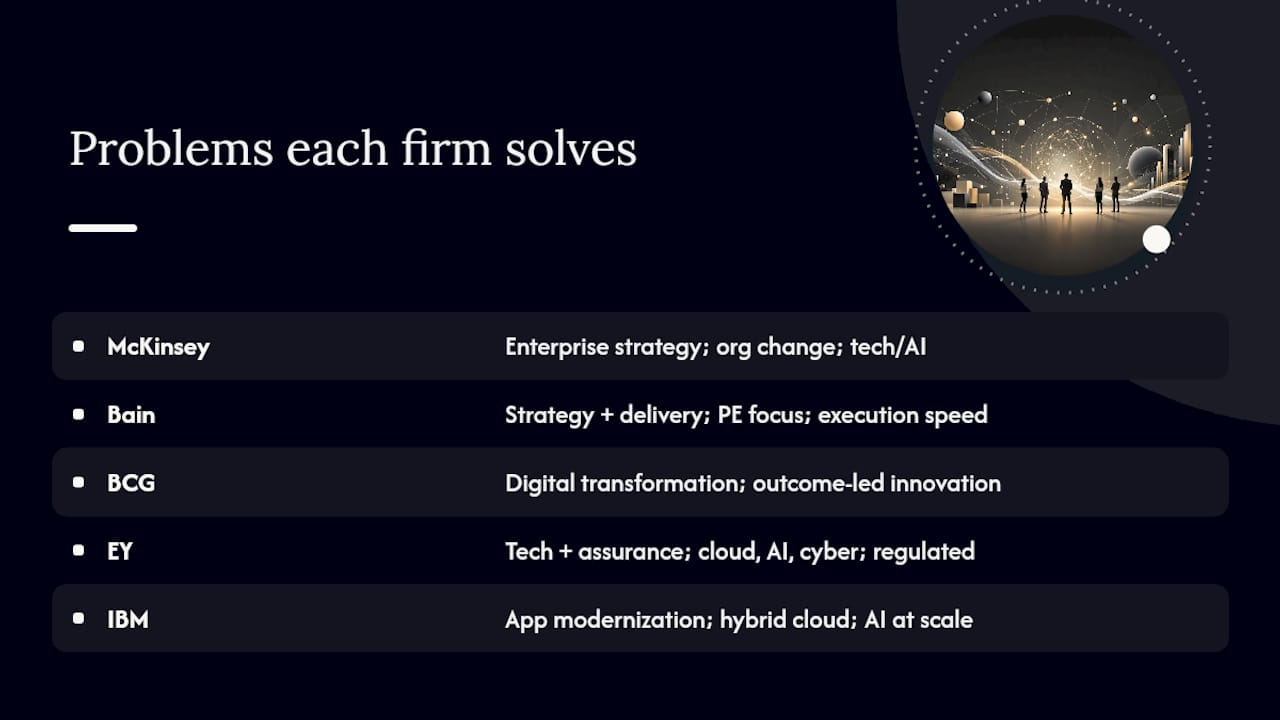
What problems do McKinsey, Bain, BCG, EY, and IBM typically solve?
These five names appear on most shortlists for large-scale engagements. Each has a distinct center of gravity.
McKinsey & Company is most often engaged for enterprise strategy, operating model design, and large-scale technology and AI transformation programs. Its Tech & AI practice focuses on aligning technology investment to specific business domains where EBITDA impact can be demonstrated. McKinsey tends to work with C-suite leadership and is best suited to problems that require both strategic framing and organizational change management.
Bain & Company combines strategy with delivery, emphasizing execution discipline alongside ambition. Its technology practice is built around multidisciplinary teams and an integrated delivery model. Bain is frequently engaged for private equity portfolio company transformations and situations where speed of execution is as important as strategic clarity.
Boston Consulting Group (BCG) is known for its digital transformation practice and its emphasis on incremental, outcome-led programs. It is a strong fit for organizations that want a structured innovation methodology alongside technology delivery.
EY (Ernst & Young) brings the Big 4 combination of technology consulting and assurance. Its technology practice covers cloud, data, AI, and cybersecurity, with particular strength in regulated industries (financial services, healthcare, government) where compliance and risk management are as important as capability building. EY is often engaged when a transformation has a significant regulatory dimension.
IBM Consulting operates at the intersection of technology services and proprietary platform capability (watsonx, hybrid cloud). It is best suited to large enterprises modernizing application portfolios, migrating to hybrid cloud environments, or deploying AI at scale. IBM’s consulting practice is tightly integrated with its technology products, which is an advantage when those products are already in the environment and a consideration to evaluate when they are not.
Why AI and digital transformation now dominate consulting conversations
AI and digital transformation have moved from optional capabilities to the central organizing theme of most technology consulting engagements. The shift is not primarily about technology novelty. It reflects a structural change in how competitive advantage is built and sustained.
IBM frames technology consulting as a way to accelerate business goals through application modernization, cloud, AI, and change management, and that framing now describes the majority of active engagements across firm sizes. The practical reason: organizations that have not modernized their data infrastructure cannot use AI effectively, so cloud migration, data platform work, and AI capability building tend to arrive as a connected program rather than separate projects.
BCG’s recommendation to follow an innovate → incubate → industrialize sequence reflects a hard-won lesson: organizations that try to deploy AI at scale before proving value in a contained pilot waste significant resources.
For decision-makers, the practical implication is this: any consulting firm pitching AI transformation should be able to show you a specific pilot they ran, the metrics they tracked, and how they scaled from pilot to production. A firm that leads with AI as a concept rather than a methodology is selling aspiration, not capability. Connecting technology strategy to business objectives before selecting any AI tool is the discipline that separates successful programs from expensive experiments.
How do you measure the success of a consulting engagement after it ends?
Post-implementation measurement is where most organizations underinvest, and it is the step that determines whether the next engagement gets funded.
Set three to five KPIs before the engagement starts, not after. Useful categories:
- Operational efficiency: Time saved per process, error rate reduction, manual steps eliminated
- Financial impact: Cost per transaction, hosting cost change, revenue from new digital channel
- Speed: Release cycle time, time-to-market for new features, incident resolution time
- Customer experience: Net Promoter Score movement, conversion rate, support ticket volume
- Risk posture: Number of open critical vulnerabilities, compliance audit findings, mean time to detect/respond
Assign ownership for each KPI to a named internal person, not the consulting firm. The firm should help design the measurement framework and hand it off at close. If the firm retains sole ownership of the data, that is a governance problem.
Review KPIs at 30, 60, and 90 days post-implementation. Many technology changes take 60–90 days to show their full effect as users adapt and processes stabilize. A single 30-day check-in is not enough to draw conclusions.
For automation-driven implementations, track the specific manual tasks that were automated and measure the time recaptured per week. That figure is often the most compelling internal proof point for continued investment.
Document what did not work as well as what did. A post-implementation review that only captures wins is a marketing document, not a learning asset.
The gap between what consulting promises and what actually gets delivered
The most consistent pattern in failed technology consulting engagements is not a bad strategy or a weak technology choice. It is the absence of a clear owner on the client side.
Consulting firms, even excellent ones, are temporary. They bring expertise, capacity, and methodology. What they cannot bring is institutional commitment to the outcome after they leave. Organizations that treat a consulting engagement as a handoff — “the consultants will figure it out” — almost always end up with a well-documented strategy that nobody executes, or a system that nobody operates correctly six months after go-live.
The organizations that get the most value from technology consulting are the ones that assign an internal champion before the engagement starts: someone with authority, accountability, and enough technical literacy to ask hard questions during delivery. That person does not need to be a technologist. They need to care about the outcome and have the organizational standing to act on what the consultants recommend.
For small businesses, this is actually an advantage. The owner is usually the champion by default, which means decisions get made faster and the knowledge transfer at hand-off lands with the person who will actually use it. The lean engagement model described earlier in this article is designed around that reality.
Moderatemurmurations helps small teams build and launch faster
The enterprise firms described in this article are the right choice for large-scale programs with seven-figure budgets. For small businesses, service providers, creators, and wellness brands, the better path is a focused, done-for-you implementation that produces a working digital system in weeks, not months.
Moderatemurmurations builds AI-assisted websites, landing pages, brand copy, SEO content, and digital systems for exactly this audience. The work is scoped to your actual situation: a clean website with clear messaging, an automation layer that handles lead capture or booking, and a measurement setup so you can see what is working. No long-term retainer required, no enterprise overhead.
If you are ready to move from planning to a working online presence, book a free consultation and we will scope a practical first project together.