Process Optimization: A Practical Guide for Business Leaders
Process Optimization: A Practical Guide for Business Leaders

What is process optimization, and why does it matter?
Process optimization is the practice of adjusting how work gets done so your business uses time, money, and people as effectively as possible. The core goals are consistent: minimize waste, reduce costs, improve quality, and increase throughput without violating operational constraints. Done well, it’s one of the most direct levers a decision-maker has for improving both performance and customer satisfaction.
Three methodologies have become the recognized industry standards for this work:
- Six Sigma targets defect reduction using statistical rigor, aiming for no more than 3.4 defects per million cycles.
- Lean focuses on eliminating waste across eight categories, from overproduction to unnecessary motion, tracing its roots to the Toyota Production System.
- Kaizen builds continuous, incremental improvement into the culture itself, with small changes compounding over time.
Measuring success requires concrete metrics. Process cycle efficiency (PCE) is one of the most practical: it measures value-added time as a percentage of total process time. A team that spends a portion of active time out of the total cycle operates at a measurable process cycle efficiency, indicating room for improvement. That number tells you exactly how much room exists for improvement before you touch a single tool or hire a single consultant.
Which methods and frameworks actually work?
Choosing the right methodology depends on what’s actually broken. Practitioners select Six Sigma to reduce defects, Lean to eliminate waste, and Kaizen to build a culture of continuous improvement, each matched to specific organizational pain points. No single framework fits every situation.
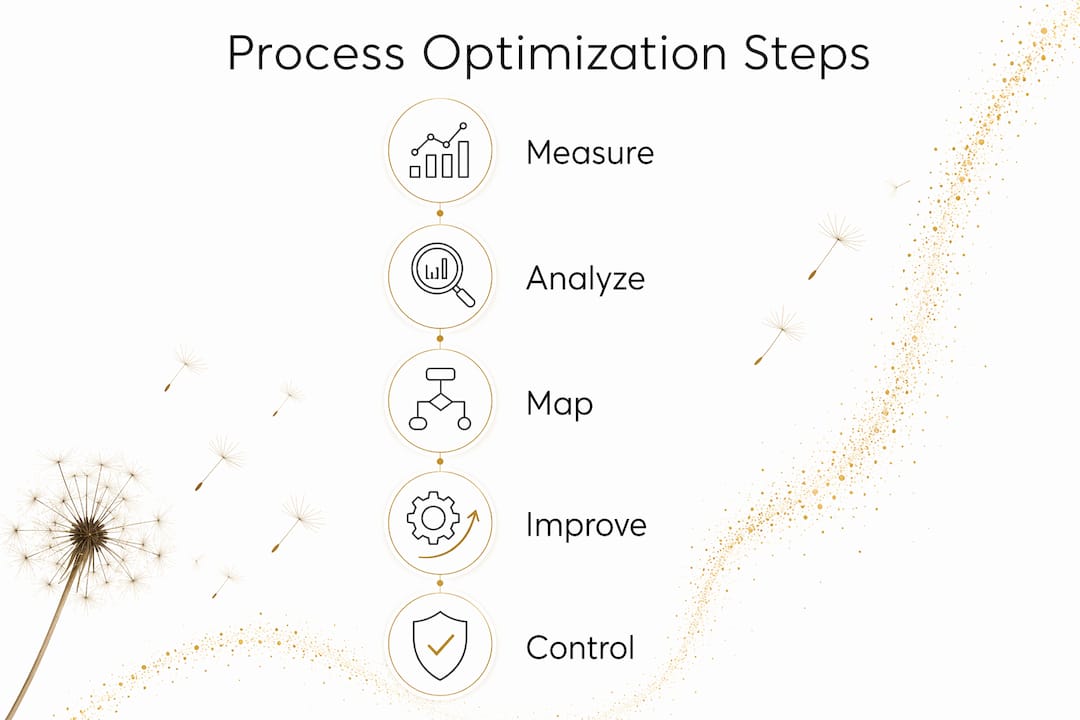
- Six Sigma / DMAIC: Best when defect rates and variability are the core problem. Uses statistical analysis to identify root causes and control outcomes. The DMAIC cycle (Define, Measure, Analyze, Improve, Control) is the standard improvement path for existing processes, while DMADV (Define, Measure, Analyze, Design, Verify) applies when building new ones.
- Lean: Targets the eight wastes: defects, overproduction, waiting, underused talent, excess transportation, inventory, unnecessary motion, and extra processing. Lean tools like 5S, Just-in-Time (JIT), and Kanban create order and predictability in workflows.
- Kaizen: Works through focused, team-driven improvement events. The word itself comes from the Japanese “kai” (change) and “zen” (good). Kaizen is core to Lean and thrives in organizations where leadership actively supports bottom-up problem solving.
- PDCA / PDSA: Plan, Do, Check (or Study), Act. A cyclical method adapted for healthcare and services by statistician Gerald J. Langley in 1996, building on Edwards Deming’s earlier manufacturing work. Useful for smaller-scale tests before committing to full rollout.
- 5 Whys: A root cause analysis technique that asks “why” repeatedly until the underlying cause of a problem surfaces. Simple, fast, and effective for diagnosing recurring issues.
- Total Quality Management (TQM): An organization-wide philosophy that embeds quality into every function, not just production. TQM requires buy-in from leadership down to front-line staff.
- Lean Six Sigma (LSS): Developed by Xerox in the early 2000s, LSS combines waste reduction from Lean with variability reduction from Six Sigma. Successful implementations typically address waste first, then apply statistical controls.
How to optimize a business process step by step
The DMAIC cycle gives you a repeatable structure for any improvement project. Here’s how it works in practice:
- Define the problem. Identify which process needs attention, who it affects, and what success looks like. Write a clear problem statement before touching anything else.
- Measure current performance. Collect baseline data on cycle times, error rates, throughput, and cost. Calculate your PCE to understand how much of the process actually adds value.
- Analyze root causes. Use tools like the 5 Whys, fishbone diagrams, or process mapping to find where and why failures occur. Don’t skip this step. Fixing symptoms without understanding causes wastes effort.
- Improve the process. Design and test solutions on a small scale first. Validate that changes produce the expected results before expanding. Prioritize improvements by financial impact, not by ease.
- Control the new standard. Document the improved process, train the team, and set up monitoring so gains don’t erode. This is where most organizations fall short: improvement without control reverts.
- Review and iterate. Schedule regular reviews to catch drift and identify the next improvement opportunity. Continuous improvement is a cycle, not a project with an end date.
Pro Tip: Map your process visually before you analyze it. A simple flowchart often reveals redundant steps, handoff delays, and approval bottlenecks that are invisible in a spreadsheet.
What do businesses actually gain from improving their processes?
The benefits of systematic process improvement show up across every part of the organization, not just in operations.
- Lower operating costs: Eliminating waste directly reduces labor, materials, and rework expenses. Lean implementations in manufacturing regularly cut cycle times and inventory carrying costs.
- Better quality and fewer errors: Six Sigma’s statistical controls reduce defect rates to near-zero levels, which translates to fewer returns, complaints, and warranty claims.
- Higher employee productivity: When people aren’t fighting broken workflows, they spend more time on work that actually matters. Removing friction from daily tasks also tends to improve morale.
- Faster, better decisions: Process improvement generates data. That data gives leaders a factual basis for decisions instead of relying on intuition or anecdote.
- Greater agility: Organizations with documented, standardized processes can adapt faster when market conditions shift. You can’t change what you haven’t defined.
- Stronger customer satisfaction: Consistent, reliable delivery builds trust. Customers notice when quality improves and wait times shrink.
A tool-agnostic approach to process transformation keeps the focus on financial impact rather than chasing the latest technology trend. The question to ask is always: what is this change worth to the business?
Which tools and technologies support process improvement?
Technology accelerates improvement, but only when the underlying process is already clean. The right tools depend on where you are in the improvement cycle.
- Process mapping software: Tools like Lucidchart or Microsoft Visio help teams visualize workflows, identify bottlenecks, and communicate changes clearly across departments.
- Process mining platforms: These analyze event logs from your existing systems (ERP, CRM, ticketing) to show you how processes actually run versus how you think they run. The gap is often revealing.
- Trigger-based automation: Platforms like Zapier and n8n handle reliable, rule-based tasks such as report generation, data entry, and notification routing without human intervention. They’re practical entry points for teams new to automation.
- Robotic Process Automation (RPA): For higher-volume, more complex rule-based tasks, RPA tools replicate human interactions with software systems at scale.
- AI-assisted analysis: Machine learning models can identify patterns in process data that human analysts miss, particularly in high-volume environments like logistics, finance, and manufacturing.
- Project and workflow management platforms: These centralize task tracking, deadlines, and team communication, reducing the coordination overhead that quietly kills productivity.
Pro Tip: Simplify and standardize before you automate. Automating a broken workflow doesn’t fix it. It just moves the waste faster. Get the process right first, then apply technology to scale what works. For more on applying automation to business growth, the guide on automation in scaling businesses covers the practical mechanics in detail.
Automation’s impact on B2B workflow efficiency is well documented in professional services, where routine task processing frees teams for higher-value client work.

What does process optimization look like in practice?
Real-world applications make the methodology concrete.
- Manufacturing defect reduction: A production facility applying Six Sigma’s DMAIC cycle to a recurring assembly defect might discover through measurement and analysis that a single supplier’s component tolerance is the root cause. Correcting that one variable can drop defect rates dramatically without retooling the entire line.
- Workflow automation in professional services: A consulting firm using Zapier to automate client onboarding emails, contract routing, and invoice generation can reclaim hours per week per team member. That time shifts to billable work.
- Lean waste elimination in distribution: A warehouse applying 5S and JIT principles to its picking process reduces unnecessary motion and excess inventory simultaneously. Shorter pick paths and tighter reorder triggers lower both labor costs and carrying costs.
- Kaizen in service organizations: A customer support team that holds weekly 30-minute improvement reviews, focused on one recurring ticket type at a time, builds a compounding improvement habit. Six months in, resolution times and escalation rates both drop without any new technology investment.
- Data-driven cost control: A finance team that maps its month-end close process and measures each step’s duration often finds that 60% of the time is consumed by three handoffs. Eliminating or automating those handoffs cuts the close cycle by days.
What challenges should you expect along the way?
Process improvement projects fail more often from organizational friction than from technical complexity.
Resistance to change is the most common obstacle. People protect familiar routines, especially when they weren’t involved in designing the new ones. Involving front-line staff early in the analysis phase reduces this friction considerably.
Scope creep derails many Six Sigma and Lean projects. A team that starts with one process ends up trying to fix the entire department. Tight problem statements and defined project boundaries prevent this.
Inadequate measurement is a quieter problem. Teams that skip the baseline measurement step have no way to prove improvement occurred, which makes it harder to sustain leadership support. Measure before you change anything.
Culture and buy-in can make or break a program. Six Sigma projects that require stakeholder support across departments can take more than 24 months for major improvements. That timeline demands sustained leadership commitment, not just initial enthusiasm.
Investing a substantial portion of optimization budgets in training and change management significantly improves adoption rates. Most organizations underinvest here and then wonder why the new process reverts within a quarter.
Why data and continuous improvement are inseparable
Data is what separates process improvement from guesswork. Without measurement, you’re making changes based on opinion. With it, you’re making decisions based on evidence.
Workflow optimization works best when treated as a continuous cultural habit rather than a one-time project. Regular reviews, open communication across teams, and gradual implementation build the momentum that sustains gains over time. The organizations that get the most from Lean and Kaizen are the ones that never declare the work finished.
Real-time data feeds this cycle. When teams can see process performance metrics updated daily or weekly, they catch drift early and correct it before it compounds. PCE, error rates, cycle times, and cost per unit are the numbers worth watching consistently. The goal isn’t perfection on day one. It’s a system that gets measurably better every quarter.
Key Takeaways
Systematic process improvement, grounded in methods like Six Sigma, Lean, and Kaizen, delivers measurable gains in efficiency, quality, and cost when paired with consistent measurement and cultural commitment.
| Point | Details |
|---|---|
| Start with measurement | Calculate process cycle efficiency before changing anything; 16 active hours out of 40 total equals 40% PCE. |
| Match method to problem | Use Six Sigma for defect reduction, Lean for waste elimination, and Kaizen for building a continuous improvement culture. |
| Simplify before automating | Standardize the process first; automating a broken workflow accelerates waste, not results. |
| Invest in change management | Allocating 20–30% of optimization budgets to training and change management significantly improves adoption and success rates. |
| Treat improvement as ongoing | Schedule regular reviews and track key metrics quarterly so gains compound rather than erode. |
Ready to bring cleaner systems and better workflows into your digital operations? Moderatemurmurations builds fast, well-structured digital infrastructure for businesses that want their online presence to work as efficiently as their internal processes. From AI-assisted websites to digital systems built for growth, we help you get it right from the start.