Website Launch Checklist for Small Businesses
Website Launch Checklist for Small Businesses

A website launch checklist for small businesses is a structured, step-by-step plan covering every technical, design, and marketing task required before your site goes live. 73% of small businesses now have an online presence, which means your site needs to work correctly from day one to compete. This guide walks you through the full pre-launch process, from domain registration and SSL certificates to SEO basics and post-launch growth, so nothing gets missed and your launch goes smoothly.
1. What are the essential technical foundation steps?
The technical foundation of your site determines how fast, secure, and findable it is. Skipping this phase creates problems that are expensive and time-consuming to fix later.
- Choose your domain name carefully. Keep it short, easy to spell, and close to your business name. Register a matching email address (yourname@yourbusiness.com) at the same time. A professional email builds trust immediately.
- Select reliable hosting. Look for a host with at least 99.9% uptime and fast server response times. Starting costs for a small business website typically run $50–$400 per year. That range covers most entry-level hosting plans with a domain included.
- Install an SSL certificate. SSL certificates are mandatory for security and SEO. Browsers flag non-secure sites with a “Not Secure” warning, which drives visitors away before they read a single word.
- Set up Google Analytics and Google Search Console. Both tools are free and essential for tracking who visits your site and how they find it. Install them before launch so you capture data from day one.
- Back up your website. Run a full backup of all files and your database before you flip the switch. If anything breaks during launch, you can restore in minutes instead of hours.
Pro Tip: Test your hosting speed using Google PageSpeed Insights before launch. A slow host is the single most common technical mistake first-time site owners make.
2. How to structure content and design for user experience
Your site’s content and design determine whether visitors stay or leave. A clear structure builds trust and guides people toward taking action.

Seven core pages form the foundation of a small business website: homepage, about, services or products, contact, testimonials, blog, and a privacy policy. These seven pages cover the information most visitors look for before making a buying decision.
Here is how to build each section correctly:
- Homepage. Lead with a clear value proposition in the first sentence. State what you do, who you serve, and what makes you different. Include your phone number or contact link above the fold.
- About page. Write in plain language. Tell your story briefly and connect it to why you serve your clients well. Add a real photo of yourself or your team.
- Services or products page. List each offering with a short description and a clear call to action. Avoid vague labels like “solutions” or “offerings.”
- Contact page. Include a form, your email address, and your phone number. Add your business hours and location if you serve local clients.
- Testimonials page. Real quotes from real clients outperform any marketing copy you write yourself. Include the client’s name and, if possible, their photo.
- Blog. Even two or three posts at launch signals to Google that your site is active. Write about questions your clients ask most often.
- Privacy policy. Privacy compliance under laws like GDPR and CCPA applies to small businesses too. Use a cookie consent tool and publish a clear privacy policy before launch.
Mobile responsiveness requires testing on actual phones and tablets, not just resizing your browser window. What looks fine on a desktop often breaks on a real device. Keep navigation to five to seven items with clear, descriptive labels. Avoid image carousels. They slow page load and most visitors ignore them.
Pro Tip: Check your design’s impact on conversions before launch. Small design choices, like button color and font size, directly affect whether visitors contact you.
3. What SEO and accessibility steps should you complete before launch?
SEO stands for search engine optimization. It is the practice of making your site easy for Google to read and rank. Accessibility means making your site usable for people with disabilities. Both matter before launch, not after.
- Write unique page titles and meta descriptions. Every page needs its own title tag (50–60 characters) and meta description (150–160 characters). These appear in Google search results and directly affect click-through rates.
- Generate and submit an XML sitemap. A sitemap tells Google which pages exist on your site. Submit it through Google Search Console immediately after launch.
- Add alt text to every image. Alt text describes images for screen readers and helps Google understand your visual content. Write a short, descriptive phrase for each image, not just “image1.jpg.”
- Compress all images to under 200KB. Visitors abandon sites that take longer than three seconds to load. Large images are the most common cause of slow load times.
- Check color contrast and font readability. Text must have sufficient contrast against its background. Use a minimum font size of 16px for body text.
- Test keyboard navigation. Every link, button, and form field must be reachable using only a keyboard. This is a legal accessibility requirement in many jurisdictions.
- Test on multiple browsers. Chrome, Safari, Firefox, and Edge all render sites slightly differently. Check your site in each one before launch.
Pro Tip: Run your site through Google PageSpeed Insights and Lighthouse before launch. Both tools are free and flag the exact issues holding your score back.
Here is a quick reference for the core SEO and accessibility checks:
| Check | Target |
|---|---|
| Page title length | 50–60 characters |
| Meta description length | 150–160 characters |
| Image file size | Under 200KB |
| Body font size | 16px minimum |
| Page load time | Under 3 seconds |
4. What final tests must you complete on launch day?
Launch day is not the time to discover a broken form or a missing page. A final checklist run prevents the errors that cost you clients and credibility.
- Run a full site backup. Do this immediately before going live. If anything goes wrong, you have a clean restore point.
- Disable your maintenance or “coming soon” page. This sounds obvious, but it is one of the most common launch-day oversights.
- Make your site visible to search engines. In WordPress, uncheck “Discourage search engines from indexing this site” under Settings. Other platforms have equivalent settings.
- Test every internal and external link. Click through every link on every page. Broken links frustrate visitors and hurt your SEO ranking.
- Submit your sitemap to Google Search Console. Do this manually on launch day so Google starts crawling your site immediately.
- Test all forms, buttons, and conversion paths. Testing every interaction element before launch prevents critical failures. Submit a test form yourself and confirm the email arrives.
- Clear your cache and test in incognito mode. Incognito mode shows your site without cached data, exactly as a new visitor sees it.
- Set up 301 redirects if you are replacing an old site. A 301 redirect tells Google that a page has permanently moved. Without redirects, you lose all the SEO value your old pages had built.
The online visibility checklist from Moderatemurmurations covers additional technical checks that apply specifically to service-based businesses going live for the first time.
5. What post-launch actions drive traffic and protect your site?
Launching your site is the beginning of the process, not the end. The businesses that grow online are the ones that maintain and build on their sites consistently.
- Set up automated backups. Schedule daily or weekly backups depending on how often your content changes. Store backups in a location separate from your hosting server.
- Run regular security scans. Install a security plugin or use your host’s built-in scanning tools. Malware and brute-force attacks target small business sites regularly.
- Monitor Google Analytics and Search Console weekly. Look for traffic trends, high-bounce pages, and search queries that bring visitors to your site. Use that data to improve your content.
- Start a content marketing plan. Blogging builds visibility for small businesses over time. One well-written post per month is more effective than ten rushed posts in a single week.
- Promote your site through social media and local channels. Share your launch on LinkedIn, Instagram, or Facebook depending on where your clients spend time. Submit your site to Google Business Profile for local search visibility.
- Gather client feedback and iterate. Ask your first visitors what confused them or what they could not find. Real feedback reveals problems that no checklist can predict.
Pro Tip: Start with core features and add growth tools like email capture, live chat, or booking systems once your site is stable. Adding too many tools at launch creates technical debt and slows your site.
A successful launch is a systematic, multi-phase process that begins with strategy and goals. The post-launch phase is where that strategy pays off, but only if you stay consistent.
Key takeaways
A complete small business website launch requires technical setup, content structure, SEO preparation, launch-day testing, and ongoing maintenance to succeed.
| Point | Details |
|---|---|
| Technical setup comes first | Secure your domain, hosting, and SSL certificate before building anything else. |
| Seven core pages are the minimum | Homepage, about, services, contact, testimonials, blog, and privacy policy cover what visitors need. |
| SEO starts before launch | Write unique titles, compress images, and submit your sitemap on day one. |
| Test everything before going live | Check every link, form, and button in incognito mode to catch errors visitors would find. |
| Post-launch maintenance drives growth | Weekly analytics reviews and regular backups protect your site and reveal improvement opportunities. |
What I have learned from watching small businesses launch online
The most common mistake I see is treating launch day as the finish line. Owners spend weeks perfecting their homepage, then go quiet for months after launch. The sites that grow are the ones where the owner shows up consistently after launch, adding content, fixing small issues, and responding to what the data shows.
The second mistake is skipping mobile testing on real devices. I have watched business owners approve a site on their laptop, then discover the contact button is invisible on an iPhone. Testing on real phones is not optional. It is the difference between a site that converts and one that quietly loses clients.
My honest recommendation: launch with less than you think you need. A clean, fast, five-page site that loads in two seconds will outperform a bloated twelve-page site every time. You can always add pages. You cannot undo a slow, confusing first impression. Start simple, test thoroughly, and build from there.
— Christopher
Your website launch, handled with care
Launching a website involves dozens of moving parts. Getting them all right on your own takes time you may not have.
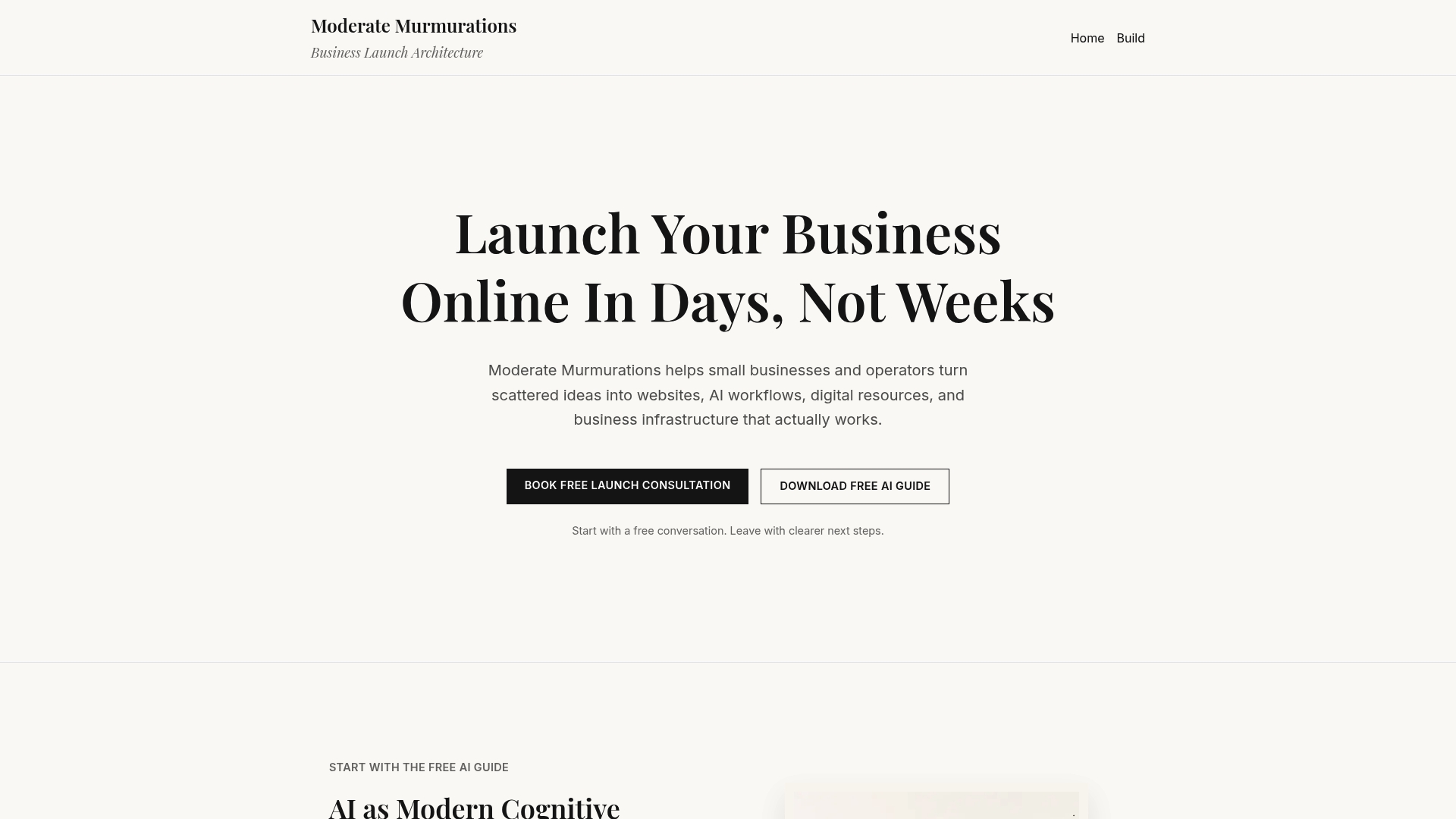
Moderatemurmurations builds fast, clean websites for small businesses, service providers, and creators who need a professional online presence without the technical headache. From domain setup and SEO foundations to AI-assisted copy and digital systems, the team handles the full build so you can focus on running your business. If you are ready to launch your business online in days rather than months, Moderatemurmurations is built for exactly that. You can also explore the full website build service to see what a complete digital setup looks like.
FAQ
How long does it take to launch a small business website?
A basic small business website takes two to six weeks to build and launch properly, depending on how quickly content and feedback are provided. Using a structured checklist shortens that timeline significantly.
What pages does a small business website need at launch?
Seven core pages cover the minimum: homepage, about, services or products, contact, testimonials, blog, and a privacy policy. Each page serves a specific role in converting visitors into clients.
Do I need an SSL certificate for a small business website?
Yes. SSL certificates are required for both security and SEO. Browsers display a “Not Secure” warning on sites without one, which reduces visitor trust and hurts your search ranking.
How much does it cost to launch a small business website?
Starting costs typically range from $50 to $400 per year for hosting and a domain. Design, copywriting, and development services add to that depending on the scope of the project.
What is the first thing to do after launching a website?
Submit your XML sitemap to Google Search Console immediately after launch. This tells Google your site exists and starts the indexing process so your pages can appear in search results.