Prompt Engineering for Small Business Owners in 2026
Prompt Engineering for Small Business Owners in 2026

What prompt engineering actually means for your business
Prompt engineering is the practice of writing clear, structured instructions that guide AI tools to produce useful, on-brand content. No coding required. Think of it as briefing a very capable but literal-minded assistant: the quality of what you get back depends almost entirely on how well you explain what you need.
For small business owners, this is a communication skill, not a technical one. You already know your customers, your tone, and your goals. Prompt engineering is just the method for translating that knowledge into instructions an AI can act on.
Every strong prompt shares four core elements:
- Role: Tell the AI who it should be (“You are a direct-response copywriter for a wellness brand”).
- Context: Share your audience, their pain points, and any relevant background.
- Task: Specify exactly what you want produced, including format and length.
- Constraints: Define what to avoid, such as jargon, competitor mentions, or a passive voice.
Iteration is built into the process. Your first prompt is a starting point, not a final answer. Follow-up instructions like “make it shorter” or “add a stronger call to action” are how you close the gap between a rough draft and something you can actually use. Prompt sensitivity is real: small wording changes produce noticeably different outputs, which is why treating each prompt as a draft worth refining pays off quickly.
The practical payoff is real. Effective prompt design saves significant time by reducing the hours you spend rewriting AI output that missed the mark.
Table of Contents
- How to craft and refine prompts that actually work
- How to align AI-generated content with your brand identity
- How Moderatemurmurations approaches prompt engineering for brand and web content
- Common challenges and misconceptions in prompt engineering
- Real prompt examples for small business scenarios
- Common pitfalls and how to avoid them
- Tools and platforms that support prompt engineering
- How to measure the impact of prompt engineering on content quality
- Key Takeaways
- Work with Moderatemurmurations
How to craft and refine prompts that actually work
A reliable process removes the guesswork. Follow these steps to build prompts that produce consistent, usable content.
- Assign a specific role. “You are a senior email copywriter for a boutique fitness studio” outperforms “write a marketing email.” The role sets vocabulary, tone, and assumptions before a single word of content appears.
- Load the context. Include your audience, their main concern, and any background the AI needs. The model cannot infer what you haven’t told it.
- State the exact task and format. “Write a 150-word Instagram caption ending with a question” leaves no room for interpretation.
- Add constraints. “No buzzwords, no passive voice, under 200 words” narrows the output toward what you want.
- Include examples. Paste a piece of copy you love and ask the AI to match its tone. This is called few-shot prompting, and it’s one of the most reliable techniques available.
- Evaluate with CRISP. Before you send a prompt, check it: Is it Clear? Does it assign a Role? Does it provide enough Input? Is it Specific? Does it include Proof (examples or context)? CRISP is a fast self-check that catches most common gaps.
- Iterate in conversation. Treat the AI like a collaborator. After the first output, follow up: “Tighten the opening sentence” or “Make the tone warmer.” Marketers who iterate three or four turns consistently get stronger results than those who accept the first draft.
Pro Tip: Write instructions as positive commands rather than negatives. “Use active voice” works better than “don’t use passive voice.” Positive framing reduces the chance the AI fixates on what to avoid rather than what to produce.
How to align AI-generated content with your brand identity
Vague brand descriptions produce vague content. Telling an AI your brand is “modern and approachable” gives it almost nothing to work with. The fix is specificity.
Replace abstract adjectives with explicit “we are / we are not” statements. For example: “We are direct and warm. We are not corporate or clinical.” Pair those with a voice spectrum scale: “On a scale from formal to casual, we sit at a 4 out of 10.” Concrete style constraints like hex color codes, font names, and specific formatting rules give the AI the same kind of brief a designer would receive.
The most reliable method is building a machine-readable brand DNA library. Rather than writing a generic tone guide, extract patterns from real brand materials: your best-performing emails, your homepage copy, a social post that got strong engagement. Paste those into a prompt and ask the AI to identify the voice patterns before it writes anything new.
Best practices for brand alignment in prompts:
- Use “do and do not” examples, not just descriptions.
- Specify sentence length preferences (“short punchy sentences, two to three per paragraph”).
- Name the emotional register you want readers to feel.
- Include a sample of accepted output and a sample of rejected output so the AI can calibrate.
Once you’ve built a voice guide this way, paste it into every future prompt as a fixed context block. Centralizing brand voice in your prompts cuts copy-editing time significantly by ending the back-and-forth where everyone is working from a different mental model of “on-brand.”
How Moderatemurmurations approaches prompt engineering for brand and web content
At Moderatemurmurations, prompt engineering sits at the center of how we build websites, landing pages, and brand copy for small businesses and creators. Our brand carries a specific aesthetic: editorial, poetic, and precise. Getting AI to honor that sensibility requires prompts that go well beyond “write website copy.”
What we’ve learned from building AI-assisted content systems:
- Generic tone words fail. We encode our aesthetic as explicit rules: sentence rhythm, punctuation preferences, the emotional register we want readers to feel.
- Prompt libraries compound over time. A well-structured prompt saved today becomes a reusable asset that speeds up every future project.
- AI workflow design matters as much as individual prompts. A single great prompt is useful; a connected system of prompts is a content engine.
- Iteration is not a sign the prompt failed. It’s the process working as intended.
When we work with a new client, we start by extracting their brand DNA from real materials, not from a questionnaire. That foundation becomes the context block we embed in every prompt we build for them, from homepage headlines to email sequences. The result is AI output that sounds like the client, not like a template.
Common challenges and misconceptions in prompt engineering
Misconception 1: You need coding skills. You don’t. Prompt engineering is a communication skill, and the main requirement is the ability to brief someone clearly.
Misconception 2: There are magic words that unlock better AI. There aren’t. What produces better output is thorough briefing and structured requests, not specific phrases.
Misconception 3: One great prompt is enough. Prompts need maintenance. As your brand evolves and as AI models update, your prompts should too. Build a library and treat it as a living document.
On prompt sensitivity: Small wording changes produce different outputs across AI models. This is not a flaw to work around; it’s a reason to design prompts carefully and evaluate them against clear criteria like CRISP before relying on them for recurring tasks.
Practical solutions:
- Keep a prompt log. Note what worked and what didn’t.
- Test the same prompt across two or three outputs before committing to it.
- Use local SEO content goals as a concrete benchmark: does the AI output serve both the reader and search intent?
Real prompt examples for small business scenarios
These scenarios show how the same principles apply across different content types.
Homepage headline: “You are a direct-response copywriter. Write three homepage headline options for a yoga studio in Austin targeting working professionals aged 30–45 who want stress relief. Each headline should be under 10 words, active voice, no jargon.”
Email subject line: “You are an email strategist. Write five subject lines for a re-engagement email to lapsed customers of a skincare brand. Tone: warm, not pushy. No emojis.”
Social media caption: “You are a social media writer for a minimalist home goods brand. Write an Instagram caption for a product photo of a ceramic mug. 80 words max. End with a question. Voice: calm, considered, never salesy.”
Service page copy: “You are a B2B copywriter. Write a 200-word service description for a bookkeeping firm targeting independent contractors. Lead with the client’s pain point. No bullet points. Conversational but professional.”
Each of these prompts assigns a role, provides context, specifies the task and format, and includes constraints. That structure is what separates output you can use from output you have to rewrite. For professional services firms, pairing this approach with scalable lead generation strategies creates a repeatable content system.
Common pitfalls and how to avoid them
Being too vague. “Write marketing content” gives the AI no direction. Always specify the channel, format, audience, and goal.
Burying the instruction. AI models weight the beginning and end of a prompt most heavily. Lead with the task, then provide context. Don’t bury the ask under paragraphs of background.
Telling instead of showing. Describing your brand voice in adjectives is less effective than pasting an example. Show the AI what good looks like.
Accepting the first draft. The first output is a starting point. Iterate. “Make the opening more direct” or “cut this by half” are legitimate next steps, not signs of failure.
Skipping fact-checking. AI output can contain inaccuracies. Always verify claims, statistics, and specific details before publishing.
Tools and platforms that support prompt engineering
Several platforms make prompt engineering more accessible for small business owners.
ChatGPT (OpenAI) handles a wide range of content tasks and supports layered, explicit instructions well. GPT-4o is the stronger choice for creative and brand-voice work.

Claude (Anthropic) handles long-context prompts reliably, making it useful for processing existing brand documents or lengthy briefs.
Gemini (Google) integrates with Google Workspace, which suits businesses already working in Docs and Sheets.
Notion AI works inside your existing notes and documents, useful for teams managing prompt libraries alongside project work.
PromptBase is a marketplace where you can find and purchase tested prompt templates for specific use cases, a practical shortcut when you’re starting out.
The tool matters less than the prompt structure. A well-built prompt on a mid-tier model outperforms a lazy prompt on the best model available.
How to measure the impact of prompt engineering on content quality
Measuring improvement doesn’t require complex analytics. A few practical benchmarks work well for small businesses.
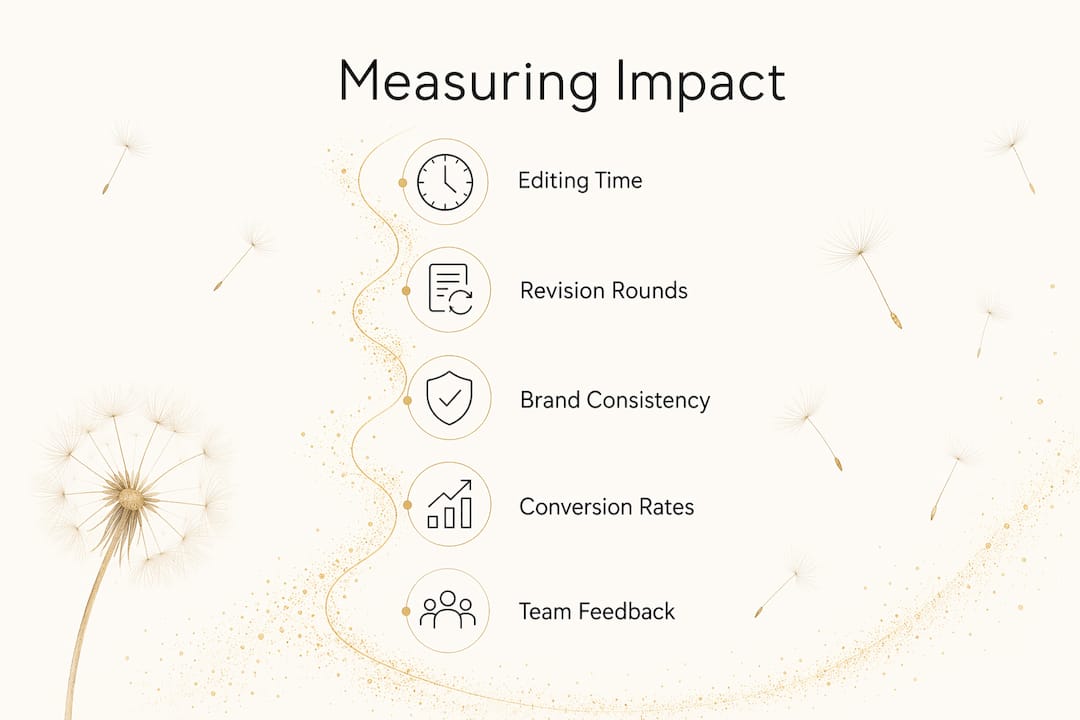
Editing time per piece. Track how long you spend revising AI output before it’s publishable. As your prompts improve, that time should drop.
Rounds of revision. Count how many follow-up prompts you need before the output is usable. Fewer rounds means better initial prompts.
Brand consistency checks. Compare AI output against your voice guide. Does it match the tone, sentence length, and register you specified? Run this check on a sample of outputs each month.
Conversion performance. For landing pages and emails, track click-through rates and conversion rates on AI-assisted copy versus previous versions. This connects prompt quality to website client acquisition in a measurable way.
Team feedback. If others on your team use the prompts, ask whether the outputs feel on-brand. Consistent positive feedback is a signal the prompt library is working.
The goal is a feedback loop: test a prompt, measure the output quality, refine, and repeat. Over time, that cycle builds a library of prompts that reliably produce content worth publishing.
Key Takeaways
Prompt engineering is a practical communication skill that small business owners can use today to produce faster, more consistent, brand-aligned AI content without any technical background.
| Point | Details |
|---|---|
| Four core elements | Every effective prompt includes a role, context, task, and constraints. |
| Iteration is the process | Follow-up prompts like “make it shorter” are how you refine output, not signs of failure. |
| Brand DNA over adjectives | Extract voice patterns from real materials and embed them as a fixed context block in every prompt. |
| CRISP as a self-check | Before sending a prompt, verify it is Clear, assigns a Role, provides Input, is Specific, and includes Proof. |
| Measure editing time | Tracking how long you spend revising AI output is the clearest signal of whether your prompts are improving. |
Work with Moderatemurmurations
Moderatemurmurations builds AI-assisted websites, brand copy, and digital systems for small businesses and creators. We handle the prompt engineering, the content structure, and the design so you get a polished online presence without the guesswork.
Launch your business online or explore how we can build your brand and content system with you.