Website Automation Tools for Entrepreneurs: 2026 Guide
Website Automation Tools for Entrepreneurs: 2026 Guide

Website automation tools for entrepreneurs are software systems that handle repetitive website and business tasks without manual input, freeing you to focus on growth. The industry term for this category is “workflow automation,” and it covers everything from lead capture to appointment scheduling to content publishing. Integrating these tools into your operations can save small businesses over $15,000 annually by cutting manual data entry and reducing app fragmentation. The good news for 2026: no-code platforms now make these tools accessible to founders with zero technical background.
What are the best website automation tools for entrepreneurs?

The right automation software for small businesses depends on what you need it to do. Tools fall into three broad categories: connector tools, agentic AI platforms, and custom app builders. Connector tools move data between apps. Agentic platforms make decisions and handle multi-step reasoning. Custom builders let you create purpose-built internal tools without writing code.
Here is a curated breakdown of the top categories and platforms worth knowing:
- Connector platforms (Zapier, Make). These tools link your apps and trigger actions based on events. Zapier suits non-technical users who want point-and-click setup. Make offers more visual workflow logic for users comfortable with branching conditions. Zapier provides 100 tasks per month free, and Make allows 1,000 operations monthly on its free tier, making both practical for testing before you commit.
- Agentic AI platforms. These go beyond moving data. They reason through tasks, qualify leads, draft responses, and handle scheduling using plain English instructions. Current AI-agent platforms accept natural language commands and require zero coding, which removes the biggest barrier most entrepreneurs face.
- CRM and email automation platforms. Tools in this category manage your contact list, send follow-up sequences, and score leads automatically. They connect directly to your website forms and trigger personalized messages based on visitor behavior.
- Appointment scheduling tools. Calendar automation eliminates back-and-forth emails. These tools sync with your calendar, show real-time availability, and send reminders without any manual input from you.
- Content scheduling platforms. Social media and blog scheduling tools let you batch-create content and publish it automatically. This keeps your online presence active even during your busiest weeks.
- Live chat and chatbot tools. Website chatbots handle common visitor questions, collect contact details, and route serious inquiries to you. They work around the clock without adding to your payroll.
- Analytics and reporting automation. These tools pull data from your website, ads, and sales channels into a single dashboard. You get a weekly summary without logging into five different platforms.
Pro Tip: Start with the connector or tool that solves your single most painful daily task. One well-configured automation you actually use beats ten half-built ones you ignore.
How to choose the right automation tools for your business
Entrepreneurs gain more by focusing on business problems than by chasing feature-heavy platforms. The selection process becomes much clearer when you follow a structured approach.
- Identify your highest-value repetitive task. Write down the three tasks that consume the most time each week. Pick the one that is most predictable and low-variance. That is your first automation target.
- Decide between connector and agentic tools. Connector tools work well for straightforward data movement, such as copying a form submission into a spreadsheet or sending a Slack notification when a sale closes. Agentic tools handle decision-making workflows like lead qualification, where the system must evaluate inputs and choose a response.
- Assess your technical comfort level. If you are not comfortable with APIs or logic conditions, start with a no-code platform that uses drag-and-drop or plain English setup. Modern AI tools are designed for founders without technical backgrounds, accepting natural language descriptions to build workflows quickly.
- Check for integration with your existing tools. A new automation platform that does not connect to your current CRM, email provider, or website creates more problems than it solves. Platforms with unified data models or strong APIs reduce silo effects and make your entire workflow more reliable.
- Avoid building complex logic with connector tools alone. Building complex logic only with connectors leads to “spaghetti workflows” that are hard to maintain and easy to break. When your automation needs to reason or branch heavily, switch to an agentic platform.
Pro Tip: Test any platform on its free tier for at least two weeks before paying. Real usage reveals friction points that demo videos never show.
Common website automation workflows you should implement first
The most effective automation workflows combine your website, email, calendar, and CRM into a single connected process. Here are the workflows that deliver the fastest results for most entrepreneurs:
- Lead capture and qualification. A visitor fills out your contact form. An agentic tool reads their answers, scores the lead, and sends a personalized follow-up email within minutes. High-value leads get flagged for your personal attention. Low-fit inquiries receive a polite automated response.
- Appointment scheduling. Your website booking widget syncs with your calendar in real time. When a prospect books a call, they receive a confirmation email, a calendar invite, and a reminder 24 hours before the meeting. You do nothing manually.
- Email triage and follow-up sequences. New subscribers from your website get added to a welcome sequence automatically. The sequence delivers value over several days and ends with a soft offer. Replies get tagged and routed to your inbox for personal response.
- Content publishing and social sharing. You write a blog post once. An automation publishes it to your website, shares it across your social channels, and adds it to your email newsletter queue. One piece of content reaches every channel without extra effort.
- Order confirmation and onboarding. When a customer purchases a product or service, an automation sends a confirmation, delivers any digital files, and triggers an onboarding email sequence. The customer feels taken care of immediately.
- Review and feedback requests. Three days after a service is delivered, an automation sends a short feedback request. Positive responses get redirected to your Google Business profile. This builds social proof without you remembering to ask.
Human-in-the-loop review gates during early automation deployments prevent cascading errors from misconfigured triggers. Add a manual approval step for any automation that sends money, deletes data, or contacts a client on your behalf. Once the workflow proves reliable, you can remove the gate.
Cost and accessibility of automation tools for startups
Automation software for small businesses has become genuinely affordable. Most platforms offer free tiers that let you test real workflows before spending a dollar.
| Platform type | Free tier limit | Paid plans start at | Best for |
|---|---|---|---|
| Connector (e.g., Zapier) | 100 tasks/month | ~$19.99/month | Simple app-to-app data moves |
| Connector (e.g., Make) | 1,000 operations/month | ~$9/month | Visual multi-step workflows |
| Agentic AI platforms | Varies by provider | ~$29/month | Decision-making, lead handling |
| Scheduling tools | Usually free tier | ~$10/month | Calendar and booking automation |
| Email automation | 500–1,000 contacts free | ~$15/month | Sequences and list management |
No-code AI platforms enable entrepreneurs to set up automated workflows within an afternoon, skipping the lengthy implementation cycles that once made automation a large-company advantage. That speed matters when you are running a business alone or with a small team.
The role of automation in scaling businesses is not just about saving time. It is about reducing the errors that come from doing the same task manually dozens of times a week. Automating one frequent, low-variance task initially yields better long-term results than trying to automate everything at once. Start with one workflow, measure the time saved, and then expand.
Key Takeaways
The most effective approach to website automation for entrepreneurs is to start with one high-frequency task, use the right tool category for that task type, and expand only after the first workflow proves reliable.
| Point | Details |
|---|---|
| Match tool to task type | Use connector tools for data movement and agentic platforms for decision-making workflows. |
| Free tiers reduce risk | Zapier and Make both offer free tiers, letting you test real automations before committing budget. |
| Start with one workflow | Automating one predictable task first builds reliability and confidence before you scale. |
| Integration prevents silos | Choose platforms that connect to your existing tools to avoid fragmented, broken workflows. |
| Human oversight matters | Add manual review gates to sensitive automations early on to catch errors before they compound. |
What I have learned about automation after working with dozens of small businesses
The biggest mistake I see entrepreneurs make is treating automation as a technology project instead of a business problem. They spend weeks evaluating platforms, comparing feature lists, and setting up elaborate workflows before they have confirmed that the underlying process actually works manually. Automation amplifies what is already there. If the process is broken, the automation just breaks faster.
My honest advice: pick your single most painful daily task and automate that one thing first. Not five things. One. The online visibility checklist for entrepreneurs I recommend to clients always starts with identifying the three tasks that eat the most time each week. That exercise alone clarifies where automation will actually move the needle.
The no-code AI tools available in 2026 are genuinely good. A founder with no technical background can build a lead qualification workflow in an afternoon. That was not true three years ago. The barrier is no longer technical skill. It is knowing where to start. Start with the pain, not the platform. Get one workflow running, watch it work for two weeks, then add the next one. That measured pace is what separates businesses that actually benefit from automation from those that have a dozen half-finished Zaps collecting dust.
— Christopher
How Moderatemurmurations helps entrepreneurs build and automate faster
Moderatemurmurations builds fast, clean websites with AI workflows and digital systems built in from the start, not bolted on later. If you are ready to move from manual tasks to a connected online presence, the website launch and automation services at Moderatemurmurations are designed specifically for small business owners, creators, and service providers.
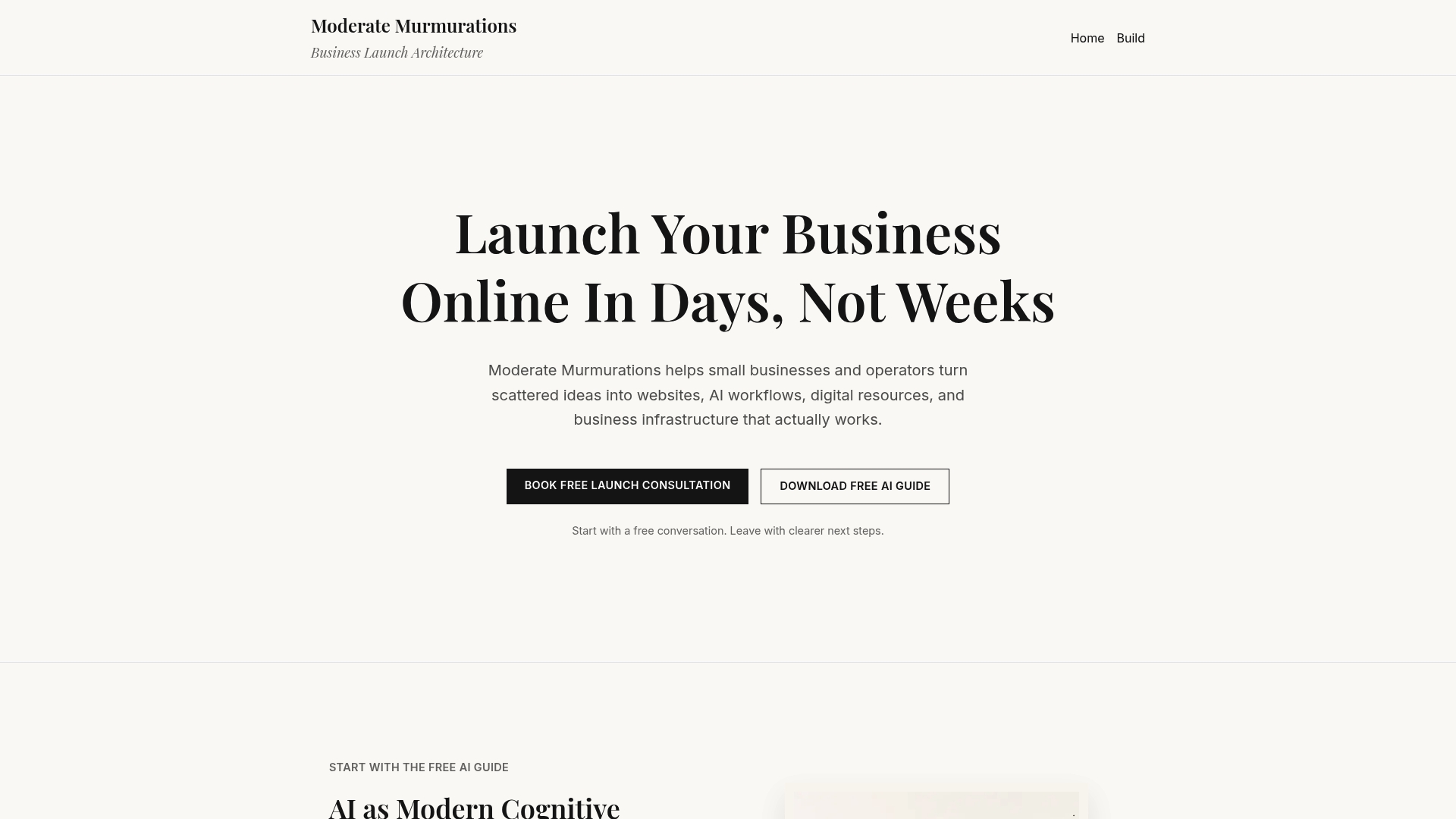
Every project includes clear messaging, search-friendly structure, and practical automation tools matched to your actual business needs. You get a polished online presence and the systems to keep it running without constant manual effort. Book a free consultation at Moderatemurmurations to talk through where automation can reduce friction in your business right now.
FAQ
What are website automation tools for entrepreneurs?
Website automation tools are software platforms that handle repetitive website and business tasks automatically, such as lead capture, email follow-up, and appointment scheduling. They reduce manual work and keep your business running consistently without constant attention.
How do I automate website tasks without coding skills?
No-code platforms like Make and agentic AI tools accept plain English instructions to build workflows, requiring zero programming knowledge. Most entrepreneurs can set up their first automation within a single afternoon.
What is the difference between connector tools and agentic platforms?
Connector tools move data between apps based on simple triggers, while agentic platforms reason through multi-step decisions and handle more complex tasks like lead qualification. Choose connectors for straightforward data movement and agentic tools when your workflow requires judgment.
How much do automation tools cost for small businesses?
Most platforms offer free tiers, with Zapier providing 100 tasks per month and Make offering 1,000 operations monthly at no cost. Paid plans typically start between $9 and $30 per month depending on the platform and feature set.
How many automations should I set up when starting out?
Start with one automation that addresses your most frequent, predictable task. Expanding too quickly before the first workflow is stable leads to errors and wasted setup time.