Business Growth Strategies for Small Business Owners
Business Growth Strategies for Small Business Owners

Business growth is the deliberate expansion of a company’s revenue, market presence, and operational capabilities through focused planning and execution. It is not accidental. Small business owners who treat growth as a structured discipline, rather than a hopeful outcome, consistently outperform those who rely on momentum alone. The frameworks covered here, including the BDA Growth Architecture and the Three Horizon Model, give you a clear path from where you are now to where you want to be. Whether you are in your first year or managing a team of ten, these strategies apply directly to your situation.
What are the key types of business growth every entrepreneur should know?
Business growth falls into two broad categories: organic and inorganic. Organic growth comes from internal activities like acquiring new clients, expanding service offerings, and increasing market share. Inorganic growth comes from external moves like mergers, acquisitions, and strategic partnerships. Each path carries a different risk profile and demands different resources.
The four BDA growth pathways
The BDA Growth Architecture organizes expansion into four pathways based on whether your market and solution are existing or new:
- Market Penetration: Sell more of what you already offer to the customers you already serve. This is the lowest-risk pathway.
- Solution Development: Create new products or services for your existing market. Risk increases because you are building something untested.
- Market Expansion: Take your current offer into a new market segment or geography. This requires new sales and marketing effort.
- Diversification: Enter a new market with a new solution. This is the highest-risk pathway and demands the most capital and planning.
Most small businesses should start with Market Penetration before moving outward. The further you move from what you know, the more resources and time the move requires.
Growth stages and what they mean for your strategy

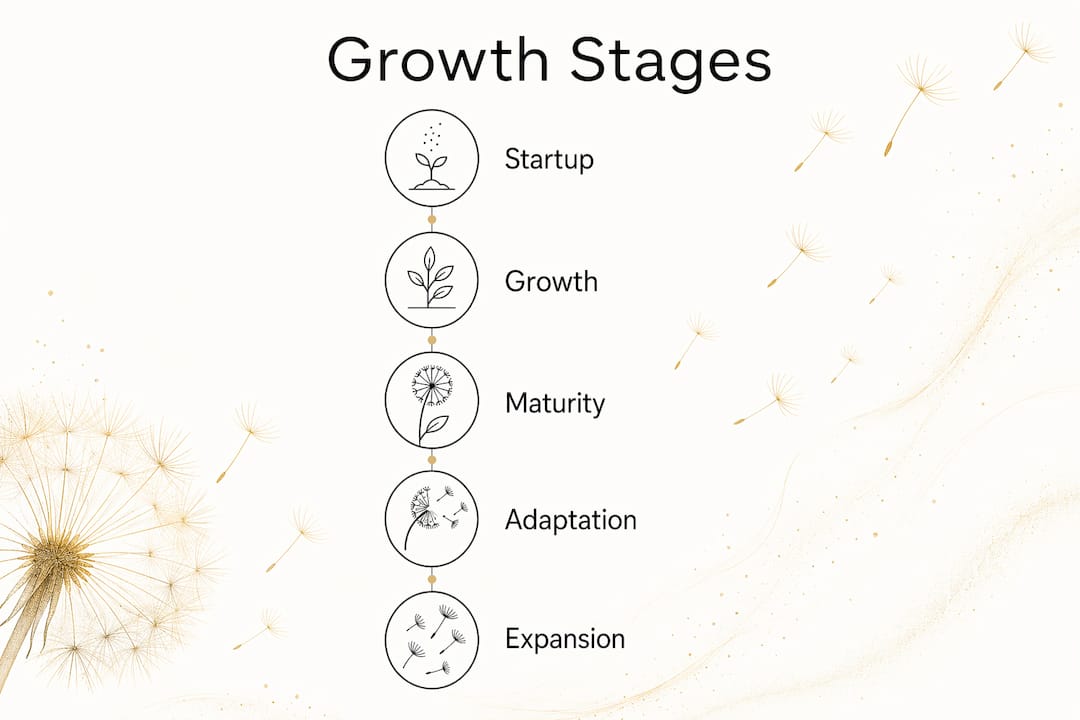
Small businesses typically move through three stages: startup, growth, and maturity. Each stage changes your priorities.
| Stage | Primary Challenge | Strategic Focus |
|---|---|---|
| Startup | Proving the model | Customer acquisition and product fit |
| Growth | Managing demand | Systems, hiring, and cash flow |
| Maturity | Sustaining momentum | Retention, diversification, and efficiency |
Recognizing your current stage prevents you from applying the wrong tactics. A startup applying maturity-stage retention programs wastes time. A mature business ignoring retention leaves money on the table.
How can you build a structured business growth plan?
A growth plan should target a 12–36 month horizon with specific, measurable objectives. Vague ambitions like “grow revenue” do not work. A plan needs defined milestones, assigned ownership, and a realistic budget.
Follow these steps to build one that holds up under pressure:
- Define your growth focus areas. Choose one or two pathways from the BDA framework. Spreading across all four at once dilutes effort and budget.
- Evaluate your current performance. Audit revenue by channel, identify your top constraints, and map the risks that could slow you down.
- Set your budget and forecast. Assign specific dollar amounts to each initiative. Forecasting without a budget is guessing.
- Build your execution plan. List initiatives with milestones, dependencies, and a named owner for each. Growth strategies without execution plans consistently underperform against their targets.
- Select your KPIs. Use a mix of lagging indicators (revenue, profit), leading indicators (pipeline value, lead volume), and operational metrics (fulfillment time, client satisfaction score).
Pro Tip: Set a monthly review date in your calendar before you launch the plan. Plans that lack a scheduled review get abandoned within 90 days.
Tracking the right KPIs separates businesses that course-correct quickly from those that discover problems too late. Use a digital growth roadmap to connect your marketing, sales, and operational systems into one visible plan.
What proven strategies help small businesses scale without burnout?
Growth and scaling are not the same thing. Growth increases revenue and costs together. Scaling increases revenue significantly faster than costs by decoupling labor from output through technology and standardized systems. That distinction matters enormously for small business owners who are already stretched thin.
The most effective tactics for scaling without burning out include:
- Document your SOPs. Automation and repeatable processes reduce owner dependency and create workflows that others can follow without constant supervision.
- Automate follow-ups, scheduling, and review requests. Automation handles increased workloads without adding headcount. This is the fastest way to reclaim your time.
- Use analytics to guide decisions. Gut instinct gets you started. Data keeps you on track. Learn how to set up analytics to measure the KPIs that matter most to your growth stage.
- Block weekly strategic time. Weekly 30–60 minutes of dedicated leadership time improves strategic focus and prevents reactive management from consuming your week.
- Avoid growth hacking shortcuts. Over-investing in short-term revenue tactics at the expense of medium and long-term capabilities creates unsustainable swings. Consistency beats cleverness.
Pro Tip: Treat your weekly CEO time as a non-negotiable appointment. Put it on your calendar, close your email, and review your KPIs before responding to anything else.
Technology works best as a growth accelerator, not just a cost cutter. Successful growth leaders combine funding discipline with diversified growth engines. That means building multiple revenue channels rather than relying on a single source.
How do financial planning and operations support business expansion?
Cash flow is the most common bottleneck during rapid expansion. Financial discipline and realistic forecasting reduce the risks that come with scaling. Many small businesses stall not because demand disappears, but because they run out of cash while trying to meet it.
The four operational pillars that underpin sustained expansion are customer service, cash flow, capability, and culture. These are the 4 C’s of scaling. Each one must grow alongside revenue, or the whole system strains.
Practical financial and operational priorities include:
- Prioritize investments by return timeline. Short-term investments should fund themselves within 90 days. Longer-term investments need a clear payback model.
- Build systems that decouple costs from revenue. When you add a new client, your costs should not rise proportionally. That gap is where profit lives.
- Track both financial and operational KPIs. Revenue and profit tell you what happened. Fulfillment time, churn rate, and lead conversion tell you what is about to happen.
- Protect your retention rate. A 5% improvement in customer retention can increase profits by 25%–95%, according to Bain & Company research. Keeping existing clients is almost always cheaper than acquiring new ones.
Applying the 1% Rule, making consistent small improvements across operations, sales, and leadership, compounds into significant gains over a 12-month period. No single change transforms a business. Dozens of small, deliberate improvements do.
Key Takeaways
Sustainable business growth requires a structured plan, the right framework, and consistent execution across financial, operational, and marketing systems.
| Point | Details |
|---|---|
| Define your growth type | Choose organic or inorganic growth based on your resources and risk tolerance. |
| Use the BDA framework | Start with Market Penetration before moving to higher-risk pathways like Diversification. |
| Plan for 12–36 months | Set specific milestones, assign ownership, and review progress monthly. |
| Scale, don’t just grow | Decouple labor from revenue by documenting SOPs and automating repeatable tasks. |
| Protect cash flow | Retain existing clients and forecast realistically to avoid stalling during expansion. |
The growth mistake I see most often
Most small business owners I work with confuse activity with progress. They launch a new offer, run a promotion, post more content, and then wonder why revenue stays flat. The problem is not effort. The problem is that none of those moves connect to a defined growth pathway or a measurable target.
The BDA framework changed how I think about this. When you force yourself to choose one of the four pathways and commit resources to it, everything else becomes easier to say no to. That clarity is worth more than any tactic.
The other pattern I see constantly is owners treating growth and scaling as the same word. They hire more people to handle more work, costs rise with revenue, and margins stay thin. Real scaling means building systems that handle more volume without proportional cost increases. That requires upfront investment in automation and documentation, which feels slow at first. The payoff comes six months later when you are not the bottleneck anymore.
My honest advice: spend less time on growth hacks and more time on your weekly CEO review. Thirty minutes a week reviewing your KPIs and adjusting your plan will outperform any shortcut. Growth is a discipline, not a discovery.
— Christopher
How Moderatemurmurations supports your growth systems
Small business growth stalls when digital infrastructure cannot keep pace with demand. Moderatemurmurations builds the online foundation that keeps your growth plan moving, from fast-loading websites and AI workflows to SEO content and brand copy that converts.

Whether you need a complete website launch or a full digital system with automation built in, Moderatemurmurations delivers clean, search-ready infrastructure in days, not months. The build services include website launch, AI workflow setup, and digital systems designed to support the kind of scaling this article describes. If your growth plan is ready but your online presence is not, that gap is worth closing now.
FAQ
What is business growth, exactly?
Business growth is the planned expansion of a company’s revenue, market presence, and operational capabilities through structured strategy and execution. It requires defined goals, resource allocation, and regular review.
What is the difference between growth and scaling?
Growth increases revenue and costs at a similar rate. Scaling increases revenue significantly faster than costs by using automation and standardized systems to decouple labor from output.
How long should a business growth plan cover?
A growth plan should target a 12–36 month horizon with specific milestones and named owners for each initiative. Shorter plans lack strategic depth; longer ones become too speculative to execute.
What are the four BDA growth pathways?
The BDA Growth Architecture defines four pathways: Market Penetration, Solution Development, Market Expansion, and Diversification. Each carries a different risk level based on how new the market and solution are.
Why does customer retention matter for business expansion?
Retaining existing clients costs less than acquiring new ones, and a 5% improvement in retention can increase profits by 25%–95%. Strong retention also stabilizes cash flow during high-growth phases.