Local Business SEO in 2026: What You Need to Know
Local Business SEO in 2026: What You Need to Know

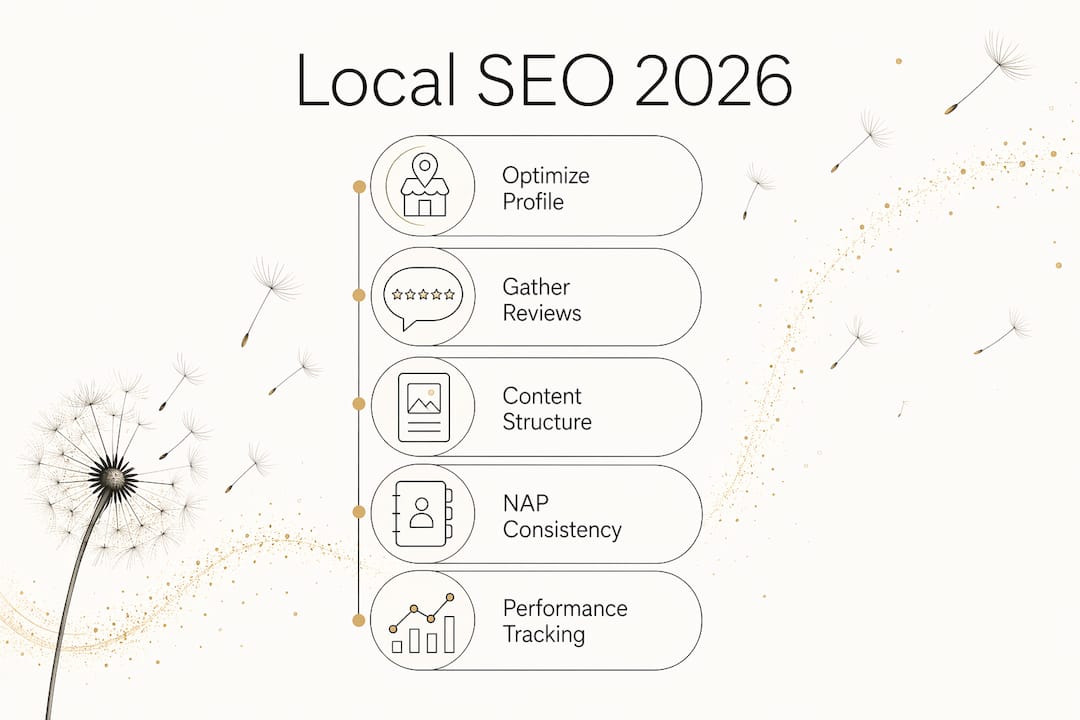
Local business SEO in 2026 is defined as the practice of optimizing your digital presence to appear in both traditional local search results and AI-generated answers. The field has shifted sharply. AI-powered features now appear on 57–80% of local informational search queries, making Generative Engine Optimization (GEO) a required skill alongside classic local search engine optimization. Google Business Profile signals, review velocity, NAP consistency, and LocalBusiness schema markup are the four pillars every local business owner and marketer must control in 2026. This guide covers each one clearly, so you can build a local SEO strategy that works in an AI-first world.
How AI-powered search engines reshape local SEO strategies
AI search features have fundamentally changed how local businesses get found. ChatGPT usage for local recommendations grew from 6% to 45% in a single year. That shift means a significant portion of your potential customers are now asking an AI chatbot for a plumber, a dentist, or a yoga studio, not typing into a search bar.
Generative Engine Optimization (GEO) is the practice of structuring your content so AI engines can read, understand, and cite your business in their generated answers. It sits alongside traditional local SEO, not in place of it. Businesses that ignore GEO are invisible to a growing share of local searches.
The difference between an AI-powered local pack and a traditional local pack matters. Traditional packs pull from Google’s index based on proximity, relevance, and prominence. AI-powered responses synthesize multiple sources, including your website, your Google Business Profile, and your reviews, then generate a recommendation. Your content must be machine-readable to win that citation.
Here is what AI engines look for when selecting local businesses to recommend:
- Structured data: LocalBusiness schema markup tells AI engines your name, address, phone number, hours, and services in a format they can parse instantly.
- Specific, location-tagged content: City-specific landing pages and service pages with geographic context give AI engines the exact signals they need.
- Review quality: Detailed reviews mentioning your services and city outperform generic praise in AI citation selection.
- Consistent entity signals: Your business name, address, and phone number must match across every platform.
- Topical authority: Publishing focused, specific content about your services builds the credibility AI engines use to rank recommendations.
Pro Tip: Test your own AI visibility right now. Search for your service category and city in ChatGPT or Perplexity. If your business does not appear, you have a GEO gap to close.
How to optimize your Google Business Profile for local rankings

Google Business Profile (GBP) is the single most controllable ranking factor in local SEO. GBP signals account for 32% of local pack ranking weight, and eight of the top ten local pack signals derive directly from GBP data. A complete, accurate profile is not optional. It is the foundation.
Follow these steps to get your GBP working at full strength:
- Claim and verify your profile. An unverified profile cannot rank. Complete verification through Google’s postcard, phone, or video process before doing anything else.
- Choose the right primary category. Your primary category carries the most ranking weight. Pick the most specific category that matches your core service, not a broad one.
- Complete every field. Business description, services, products, hours, and attributes all contribute to profile completeness. Incomplete profiles lose ranking ground to competitors who fill everything in.
- Add high-quality photos regularly. Profiles with current photos receive more clicks and direction requests. Upload photos of your location, team, and work at least once a month.
- Keep hours accurate. Outdated holiday hours or incorrect closing times damage trust with both Google and customers. Update hours before every holiday period.
- Use the posts feature. Weekly GBP posts signal an active business and give AI engines fresh content to reference.
- Add your service area correctly. If you serve customers at their location, define your service area clearly. Mismatched service areas confuse both Google and AI systems.
Pro Tip: Add your most important services as individual GBP service items with descriptions. AI engines pull from these descriptions when generating local recommendations.
Why reviews and citations define your local SEO standing in 2026
Reviews are now a ranking signal and an AI citation signal at the same time. Review signals account for 20% of local pack ranking weight, and the bar for competitive markets has risen. A minimum of 50 reviews is the baseline for competitive rankings, with 100 or more reviews recommended for high-intent search terms.
Review velocity matters more than a static high rating. A business with 80 reviews collected over the past six months outranks a business with 200 reviews collected three years ago. Google and AI engines treat recent reviews as evidence that your business is active and trusted right now.
The content of reviews matters as much as the quantity. AI engines synthesize real-time review sentiment and value reviews mentioning specific services and locations. A review that says “Dr. Chen gave me the best dental cleaning I’ve had in Austin” carries more AI citation weight than a review that says “Great service, highly recommend.” Encourage your customers to be specific when they leave feedback.
Citation consistency is equally critical. Inconsistent NAP creates entity ambiguity and greatly reduces AI recommendation likelihood. If your business is listed as “Smith Plumbing” on Google, “Smith Plumbing LLC” on Yelp, and “Smith’s Plumbing” on your website, AI systems cannot confidently identify you as a single trusted entity. Audit your citations across major directories including Google, Apple Maps, Bing Places, and industry-specific directories, then standardize every listing.
Building reviews ethically means asking at the right moment. Request a review immediately after a positive customer interaction, by text or email, with a direct link to your GBP review form. Never offer incentives for reviews. Google’s guidelines prohibit it, and AI engines are increasingly good at detecting review patterns that look artificial.
What website content and technical SEO do for AI visibility
Your website is the second major source AI engines use to verify and cite your business. On-page content structured with LocalBusiness schema markup and city-specific landing pages significantly boosts AI citation likelihood. Schema markup is code added to your website that labels your business data in a format search engines and AI systems read directly.
The table below shows the core technical elements that support AI visibility and what each one does:
| Technical element | What it does for local AI visibility |
|---|---|
| LocalBusiness schema markup | Labels your NAP, hours, and services for machine extraction |
| City-specific landing pages | Provides geographic context AI engines use for location-based answers |
| FAQ schema on service pages | Feeds structured Q&A directly into AI-generated responses |
| Mobile-friendly design | Required for Google indexing and AI content extraction |
| Fast page load speed | Slow pages are deprioritized by both Google and AI crawlers |
City-specific landing pages deserve special attention. A single “Services” page does not tell AI engines where you operate with enough precision. A page titled “Roof Repair in Denver, CO” with detailed service descriptions, local landmarks, and customer testimonials gives AI systems the geographic and topical specificity they need to recommend you for Denver-based searches. The role of design in conversions also matters here. Pages that load fast and present information clearly perform better in both human and AI evaluation.
Topical authority is the concept of covering your service area deeply rather than broadly. A roofing company that publishes detailed content about roof types, storm damage repair, insurance claims, and seasonal maintenance builds more authority than one with a single generic services page. AI engines use topical depth as a trust signal when selecting which businesses to recommend.
Pro Tip: Add an FAQ section to every service page using FAQ schema markup. These structured questions and answers are prime candidates for AI-generated response inclusion.
How to measure and sustain local SEO performance in 2026
Measuring local SEO now requires tracking six distinct areas. A comprehensive local SEO audit in 2026 covers Google Business Profile accuracy, NAP consistency, review health, on-page local signals, technical SEO, and AI search visibility. AI search visibility is the newest audit category, and most local businesses have not added it yet.
Run a full audit on this schedule:
- Monthly: Check GBP for accuracy, respond to all new reviews, and post at least two GBP updates.
- Quarterly: Audit NAP consistency across all major directories. Fix any discrepancies immediately.
- Quarterly: Test AI visibility by searching for your top five service and city combinations in ChatGPT, Perplexity, and Google AI Overviews. Note which competitors appear and why.
- Quarterly: Review your website’s schema markup using Google’s Rich Results Test tool. Confirm LocalBusiness and FAQ schema are error-free.
- Biannually: Conduct a full technical SEO audit covering page speed, mobile usability, and crawl errors.
- Biannually: Assess your local backlink profile. Local backlinks and branded search volume help differentiate top local pack rankings beyond GBP and reviews alone.
Tracking AI citation presence requires manual testing right now. Search your key service and city combinations in major AI tools and record whether your business appears. Build a simple spreadsheet to track this monthly. Over time, you will see which content changes and review improvements move the needle.
Key Takeaways
Local business SEO in 2026 requires optimizing for AI-generated answers, Google Business Profile completeness, review velocity, and consistent NAP data across all platforms.
| Point | Details |
|---|---|
| AI visibility is now mandatory | AI features appear on 57–80% of local queries, making GEO a core SEO skill. |
| GBP drives the most ranking weight | Google Business Profile signals account for 32% of local pack ranking, the highest controllable factor. |
| Review velocity beats static ratings | Recent, service-specific reviews outrank older high-star counts for both Google and AI citations. |
| Schema markup feeds AI engines | LocalBusiness and FAQ schema let AI systems extract and cite your business accurately. |
| Quarterly audits protect your ranking | Regular checks of GBP, NAP, reviews, and AI visibility prevent ranking gaps from compounding. |
What I’ve learned about local SEO in the AI era
The businesses I see winning in local search right now are not the ones with the biggest budgets. They are the ones that treat their Google Business Profile like a living document, not a set-it-and-forget-it task. They post updates, add photos, and respond to every review within 24 hours. That consistency compounds over months in ways that a one-time SEO sprint never can.
The shift to AI-powered search feels threatening to a lot of local business owners. I think it is actually an advantage for businesses willing to do the work. AI engines favor businesses with clear, specific, well-structured information. That means a well-maintained GBP, detailed service pages, and genuine reviews with real specifics beat a large competitor with a bloated website and generic content.
The one mistake I see most often is ignoring AI search visibility entirely. Owners check their Google rankings but never test what ChatGPT or Perplexity says about their business. Those tools now influence real buying decisions. Checking your AI presence takes ten minutes a month. Not checking it is a gap your competitors will fill.
The online visibility checklist for entrepreneurs I recommend covers both traditional and AI-specific signals in one place. Start there if you want a structured way to audit where you stand before building out a full local SEO strategy.
— Christopher
How Moderatemurmurations helps local businesses build for AI search
Local SEO in 2026 requires a website that is fast, structured, and readable by both humans and AI engines. Moderatemurmurations builds exactly that.
Moderatemurmurations creates websites with built-in LocalBusiness schema markup, city-specific landing pages, and clean technical foundations that AI search engines can read and cite. Every site we build is designed to support your local search presence from day one, not as an afterthought. For businesses that want to go further, our AI workflow integrations connect your digital systems to support ongoing content updates, review management, and local SEO maintenance. If you are ready to build an online presence that works in 2026’s AI-first search world, we are ready to help.
FAQ
What is local business SEO in 2026?
Local business SEO in 2026 is the practice of optimizing your online presence to appear in both traditional local search results and AI-generated answers from tools like Google AI Overviews and ChatGPT. It combines Google Business Profile management, review building, NAP consistency, and schema markup.
How much do reviews affect local SEO rankings?
Review signals account for 20% of local pack ranking weight. A minimum of 50 reviews is the competitive baseline, with 100 or more recommended for high-intent search terms.
What is Generative Engine Optimization (GEO)?
GEO is the practice of structuring your website content and business data so AI search engines can extract and cite your business in their generated responses. It includes schema markup, city-specific pages, and detailed review content.
How often should I audit my local SEO?
Run a monthly check on your Google Business Profile and reviews, a quarterly audit of NAP consistency and AI search visibility, and a full technical SEO audit every six months.
Do I need separate pages for each city I serve?
Yes. City-specific landing pages with detailed service descriptions and geographic context give AI engines the location signals they need to recommend your business for searches in those areas.