Emerging Technology for Small Businesses and Creators
Emerging Technology for Small Businesses and Creators

The single best first move for a small business, creator, or wellness brand right now is to pilot an AI-assisted website design and personalization stack. Gartner identifies AI-native development platforms as a top strategic trend, and Deloitte confirms that AI adoption is shifting from experimentation to measurable business impact. The Office of the Director of National Intelligence notes that smaller actors now access capabilities that were previously out of reach, which means the window to move first is real and closing. Start with one focused pilot, measure it, and build from there.
Table of Contents
- What should you try first, and what will it cost?
- Which emerging technologies actually matter for your site?
- How do these tools show up on real websites and funnels?
- How do you evaluate and adopt new tech without wasting money?
- How do your tools create a data flywheel?
- What guardrails do U.S. small businesses need?
- Your 30/60/90-day quick-start checklist
- How wellness brands are putting this into practice
- How do you keep your team sharp as these tools evolve?
- How do you scale beyond the pilot?
- How do you measure digital growth after adoption?
- Key Takeaways
- Why most small teams stall, and how to avoid it
- What Moderatemurmurations can build for you in 30 days
- Useful sources and further reading
What should you try first, and what will it cost?
A 30/60/90-day pilot keeps scope tight and results visible fast.
- Days 1–30: Choose one page or funnel. Deploy an AI-assisted site or landing page using a low-code builder with built-in AI (Framer, Webflow, or similar). Set a baseline for conversion rate and page load time before you launch.
- Days 31–60: Layer in basic personalization. Connect a lightweight analytics stack (Plausible, GA4, or Fathom) and test one adaptive element, such as a headline variant or a dynamic call-to-action block.
- Days 61–90: Measure, document, and decide. Did conversion rate move? Did time-to-publish drop? Use those answers to scope the next phase.
Budget range: $200–$800 for a solo operator or small team covers most SaaS tools for a 90-day pilot. Assign one owner, track two metrics, and set a clear pass/fail threshold before you start.
Which emerging technologies actually matter for your site?
Not every future technology on a Gartner list applies to a yoga studio or a solo consultant. These are the ones worth your attention:
- AI-native development platforms: Tools where generative AI is the foundation, not a bolt-on. They let a small team build, test, and iterate a site in days rather than weeks.
- Personalization engines: Software that adapts page content, offers, or CTAs based on visitor behavior. On a wellness site, this might mean showing a “new client” offer to first-time visitors only.
- Domain-specific AI models: Smaller models trained on a specific niche (health, legal, e-commerce) that outperform general models on narrow tasks like writing intake forms or product descriptions.
- Multiagent systems: Multiple AI agents coordinating tasks, such as one drafting a blog post while another schedules it and a third checks SEO. Still early, but worth watching.
- Headless CMS: A content management system that separates content from presentation, letting you publish to a site, an email, and a social feed from one place.
- Low-code/no-code builders: Platforms like Webflow, Framer, or Squarespace that let non-developers build and update professional sites without writing code.
- Fast hosting and CDN: Content delivery networks (Cloudflare, Fastly) that serve your site from servers close to your visitors, cutting load time and improving SEO scores.
- Analytics and attribution stacks: Tools that connect traffic sources to actual conversions, so you know which channel is driving bookings, not just clicks.
How do these tools show up on real websites and funnels?
Concrete use cases make the difference between a technology that sounds interesting and one that earns its place in your stack.
- AI-assisted design and landing pages: A wellness brand uses an AI-native builder to generate a hero section, headline variants, and a booking CTA in under an hour. The metric to track is time-to-launch. Implementation note: start with a single service page, not a full site rebuild.
- Personalized sign-up flows: A creator offers a free resource. Visitors from Instagram see a social-proof version of the opt-in page; visitors from search see a benefit-led version. Track opt-in rate by source.
- Automated content generation: A small studio uses an AI writing tool (Claude, ChatGPT, or Jasper) to draft weekly newsletter content from a short brief. Track time saved per issue and unsubscribe rate to confirm quality holds.
- Chat and voice booking assistants: A massage therapist embeds a simple AI chat widget that answers FAQs and links directly to a booking calendar. Metric: reduction in back-and-forth emails before a booking is confirmed.
- Analytics-driven A/B testing: A service provider runs two versions of a pricing page using a tool like Google Optimize or VWO. Metric: conversion rate per variant over 30 days.
Pro Tip: Sequence matters. Build your analytics foundation before you add personalization. If you cannot measure a baseline, you cannot prove the personalization worked.

How do you evaluate and adopt new tech without wasting money?
A structured approach reduces risk and clarifies whether to buy a vendor solution or build your own.
- Define the objective. One sentence: what business outcome does this pilot need to move?
- Set success metrics upfront. Two numbers: a primary KPI (conversion rate, time-to-publish) and a secondary one (cost per lead, page load speed).
- Scope the minimum viable pilot. One page, one funnel, one workflow. Resist the urge to do everything at once.
- Identify data capture points. Where will you collect the data that proves the pilot worked?
- Assign a single owner. Someone must be responsible for the result, even on a team of one.
Vendor vs. build: For most small teams, a vendor SaaS solution wins on time-to-value. Build only when data ownership or cost at scale tips the math. Gartner recommends modular architectures so you can swap underlying models as better options emerge, which is exactly what happened when high-performance models like Moonshot AI’s Kimi K3 appeared at low cost, shifting what “affordable AI” means almost overnight.
For a practical AI workflow design approach, redesign the process first, then automate it. Automating a broken process just makes the problem faster.
How do your tools create a data flywheel?
Deloitte’s compounding innovation insight is the most useful framing here: each digital system generates data that improves personalization and drives more efficient growth. The sequence matters.
- Step 1 (CMS + analytics): Deploy first. Every visitor interaction becomes data.
- Step 2 (personalization layer): Use that data to adapt content and offers.
- Step 3 (automation): Let rules and agents handle repetitive tasks (follow-up emails, content scheduling).
- Step 4 (optimize): Review metrics monthly and adjust the system.
For a deeper look at how digital systems compound over time, the sequencing principle applies whether you are a solo creator or a small wellness studio.
| Metric | Current state | Target after 90 days |
|---|---|---|
| Agentic AI in production | a minority of organizations | Your pilot live and measured |
| Piloting agentic systems | a notable portion of organizations | Pilot scoped and running |
| Common failure mode | Automating broken processes | Redesign process first |
Implementation tip: Build modular. Each tool should connect to the others via standard integrations (Zapier, Make, or native APIs) so you can replace one component without rebuilding the whole stack.
What guardrails do U.S. small businesses need?
Adopting faster does not mean adopting carelessly. These are the practical guardrails.
- Data minimization: Collect only what you need. If your booking form asks for a phone number you never use, remove it.
- Consent and cookie disclosures: U.S. businesses serving California residents must comply with CCPA. Use a cookie consent tool (Cookiebot, Termly) and keep your privacy policy current.
- Credential hygiene: Use a password manager and rotate API keys regularly. Never hard-code secrets into a site’s front-end code.
- Vendor SLAs: Before committing to an AI tool, check its uptime guarantee and data-processing terms. Know where your data is stored.
- Accessibility: Run your site through WAVE or axe DevTools before launch. Alt text, sufficient color contrast, and keyboard navigation are not optional.
- Model bias: If you use AI to generate client-facing content, review outputs for tone and accuracy. Domain-specific models reduce but do not eliminate this risk.
Gartner’s governance framework treats infrastructure, orchestration, and governance as equally necessary, not sequential. Build guardrails alongside your pilot, not after.
Pro Tip: Set a quarterly “tool audit” calendar event. Review every active SaaS subscription, confirm it still earns its place, and check for updated privacy terms.
Your 30/60/90-day quick-start checklist
Template A: Pilot brief
- Objective: One sentence stating the business outcome.
- Scope: One page, funnel, or workflow.
- Primary metric: The number that defines success.
- Budget: Dollar ceiling for the 90-day period.
- Owner: Name of the person responsible.
Template B: Measurement report
- Day 30: Baseline confirmed, tools live, first data collected.
- Day 60: First variant tested, early metric movement noted.
- Day 90: Results documented, pass/fail decision made, next pilot scoped.
Author Pro Tip: After the pilot ends, run a 30-minute “what did we learn” session before scoping the next one. Small teams that skip this step repeat the same mistakes in the next cycle.
How wellness brands are putting this into practice
Wellness brands are among the fastest adopters of AI-assisted web tools because their core challenge, converting a curious visitor into a booked client, maps cleanly onto what these tools do well.
A small yoga studio, for example, might use an AI-native builder to launch a class-schedule landing page in a single day, then connect it to a booking tool like Acuity or Mindbody. An automated follow-up sequence (built in Mailchimp or Kit) sends a “welcome” email to new sign-ups without any manual effort. Within 60 days, the studio has a measurable funnel: traffic source, opt-in rate, booking rate, and show-up rate.
A solo health coach can use AI content tools to produce weekly educational emails from a short bullet-point brief, freeing up time for client work. Pairing that with a simple conversion-focused site design turns the newsletter into a consistent lead source. The key in both cases is starting with one outcome, measuring it, and adding complexity only after the foundation holds.
How do you keep your team sharp as these tools evolve?
The S-curve from invention to mainstream is compressing, which means small teams have roughly a limited window of opportunity to evaluate and adopt promising tools before they become standard market expectations. Staying current does not require a training budget. It requires a system.
- Assign a “tech scout” role. One person on the team (or you, if solo) spends 30 minutes a week reviewing one new tool or trend.
- Use vendor training resources. Most SaaS platforms offer free onboarding courses. Complete them before paying for external training.
- Join a peer community. Slack groups, Discord servers, and LinkedIn communities focused on your niche surface practical tool tips faster than any newsletter.
- Review the AI adoption guide for a structured approach to building AI literacy across a small team without overwhelming anyone.
How do you scale beyond the pilot?
Scaling is not about adding more tools. It is about deepening the ones that proved their value.
After a successful 90-day pilot, the next move is to expand scope, not stack. If your AI-assisted landing page improved conversion, apply the same approach to two more pages. If your automated email sequence reduced manual follow-up, extend it to cover more stages of the client journey. Forrester’s framework for emerging tech adoption frames this as moving from “prove” to “integrate,” which means embedding the tool into standard operating procedures rather than treating it as a special project.
Budget for scale differently than for pilots. A pilot can run on a trial plan or a monthly subscription. Scaling often means committing to an annual plan, training a second team member, and documenting the workflow so it survives personnel changes. For a step-by-step digital growth roadmap, the planning principles apply directly to this phase.
How do you measure digital growth after adoption?
Measurement after adoption is where most small teams lose the thread. They launch, see some positive movement, and stop tracking. The result is a tool that keeps running but no one can justify at renewal time.
Pick three metrics and own them: a traffic metric (organic sessions, email list growth), a conversion metric (booking rate, opt-in rate), and an efficiency metric (time to publish, cost per lead). Review them monthly, not quarterly. Monthly reviews catch problems early enough to fix them within the same pilot cycle.
Connect your metrics to revenue. A 5% lift in booking rate means a specific number of additional sessions per month at your average price. Framing it that way makes the tool’s value visible to anyone on the team, and makes the renewal decision straightforward. For practical content strategy examples that include measurement frameworks, the same logic applies across content, SEO, and paid channels.
Key Takeaways
Piloting an AI-assisted website and personalization stack is the highest-leverage first move for small businesses, creators, and wellness brands adopting emerging technology in 2026.
| Point | Details |
|---|---|
| Start with one pilot | Scope one page or funnel, set two metrics, and run for 90 days before expanding. |
| Sequence your tools | Deploy CMS and analytics first; add personalization and automation only after you have baseline data. |
| Build modular | Use tools that connect via standard integrations so you can swap components as better models emerge. |
| Govern as you go | Set up consent tools, credential hygiene, and accessibility checks during the pilot, not after. |
| Moderatemurmurations | Offers fast AI-assisted site launches and digital systems designed for small businesses, creators, and wellness brands. |
Why most small teams stall, and how to avoid it
The most common mistake is treating a technology pilot as a technology project. It is not. It is a business experiment with a hypothesis, a measurement plan, and a decision point. Teams that skip the measurement plan end up with a new tool they cannot evaluate and a budget they cannot justify.
The second mistake is automating a broken process. If your booking flow is confusing before AI touches it, an AI chat widget will just confuse visitors faster. Redesign the process first, then automate it. This is the single piece of advice that separates successful pilots from expensive ones, and it is backed by both Deloitte and Gartner’s analysis of why agentic projects fail.
The third mistake is over-architecting. A solo wellness practitioner does not need a multiagent orchestration system. They need a fast site, a clear offer, and a booking link that works on mobile. Start there.
What Moderatemurmurations can build for you in 30 days
Faster than hiring an agency and more focused than a DIY builder, Moderatemurmurations delivers a complete AI-assisted website or landing page with clear messaging, search-friendly structure, and a basic personalization or automation layer, built specifically for small businesses, creators, and wellness brands.
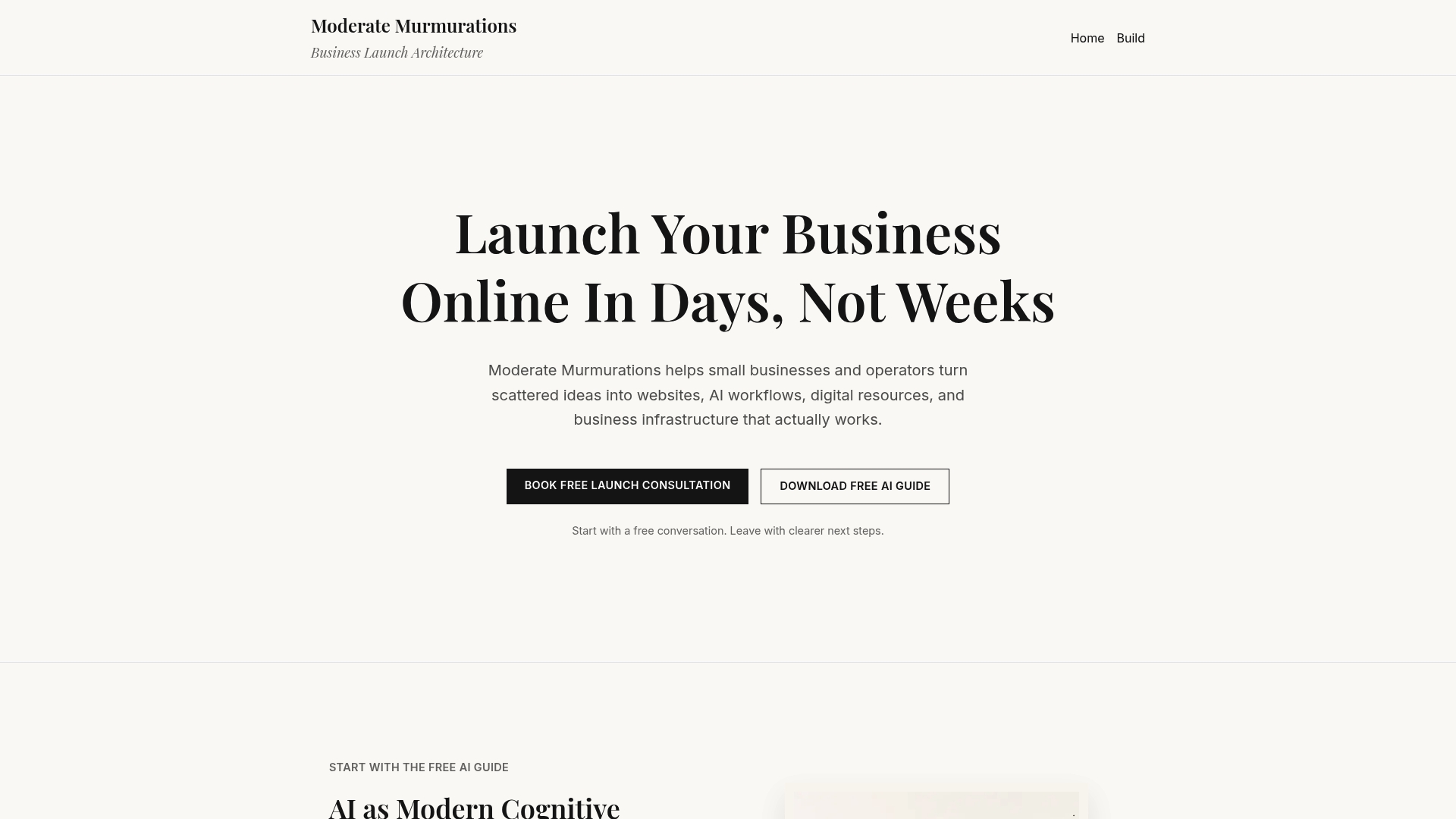
A typical pilot engagement covers one site or landing page, brand copy, SEO foundations, and one connected digital system (booking, email, or lead capture), with a scope and price range that fits small-team budgets. No long-term contracts, no bloated agency overhead.
Ready to move from pilot idea to live site? See what we build and book a free consultation to scope your first 30 days.
Useful sources and further reading
- Top Strategic Technology Trends for 2026 | Gartner — Backs the AI-native platforms and modular architecture recommendations throughout this guide.
- Tech Trends 2026 | Deloitte Insights — Source for the compounding flywheel concept, the 11%/38% agentic adoption figures, and the urgency of moving from pilots to impact.
- Global Trends: Technology | ODNI — Supports the claim that smaller actors now access capabilities previously out of reach.
- Emerging Technologies | Wikipedia — Background definition and category overview used in the shortlist section.
- Leverage Emerging Technology | Forrester — Frames the ReCPI evaluation model and benefit horizons referenced in the adoption roadmap.
- What is Kimi K3? | CNN Business — Illustrates why modular, replaceable AI foundations matter as the model landscape shifts rapidly.
- Best AI Tools for Your Business — Vendor-agnostic overview of productivity tools useful for small teams building their first AI stack.
- How Automation Transforms B2B Marketing | The Lead Lab — Practical analysis of integrating new technologies into professional services workflows.