How to Create a Digital Business Growth Roadmap
How to Create a Digital Business Growth Roadmap

A digital business growth roadmap is a structured plan that connects your digital initiatives directly to your business growth goals, giving every action a clear purpose and measurable outcome. Without one, you spend money on tactics that don’t add up to a strategy. The good news: you don’t need a large team or a big budget to build one. You need a clear process. This guide walks you through how to create a digital business growth roadmap from the ground up, using frameworks and tools that work for small businesses in 2026.
What do you need before building a digital growth roadmap?
The most common mistake small business owners make is jumping into tactics before they understand their starting point. A growth roadmap built on assumptions fails fast. Before you write a single goal, you need three things: an honest picture of your current digital presence, a defined primary customer, and one clear business outcome you want to achieve in the next 12 months.
Your current digital presence includes your website, social media activity, email list size, and search visibility. These are your baseline metrics. Without them, you have no way to measure whether your roadmap is working. Tools like Google Search Console and Google Analytics give you this data for free.

Your first-party data is your most valuable digital asset. That means your CRM contacts and email list, not your social media followers. Followers belong to the platform. Your email list belongs to you. Every channel in your roadmap should be designed to capture and grow that owned audience.
Internal buy-in matters too. If you have a team, they need to understand the plan and their role in it. A roadmap that only lives in your head is not a roadmap. It’s a wish list.
Key tools and resources to have ready
| Resource | Purpose |
|---|---|
| Google Analytics or equivalent | Track website traffic and user behavior |
| CRM or email platform | Manage and grow your owned audience |
| Keyword research tool | Identify search demand for your content |
| Project management tool | Assign owners, timelines, and tasks |
| Financial projection model | Cover 12–24 months of expected costs and returns |
How do you create a digital business growth roadmap step by step?
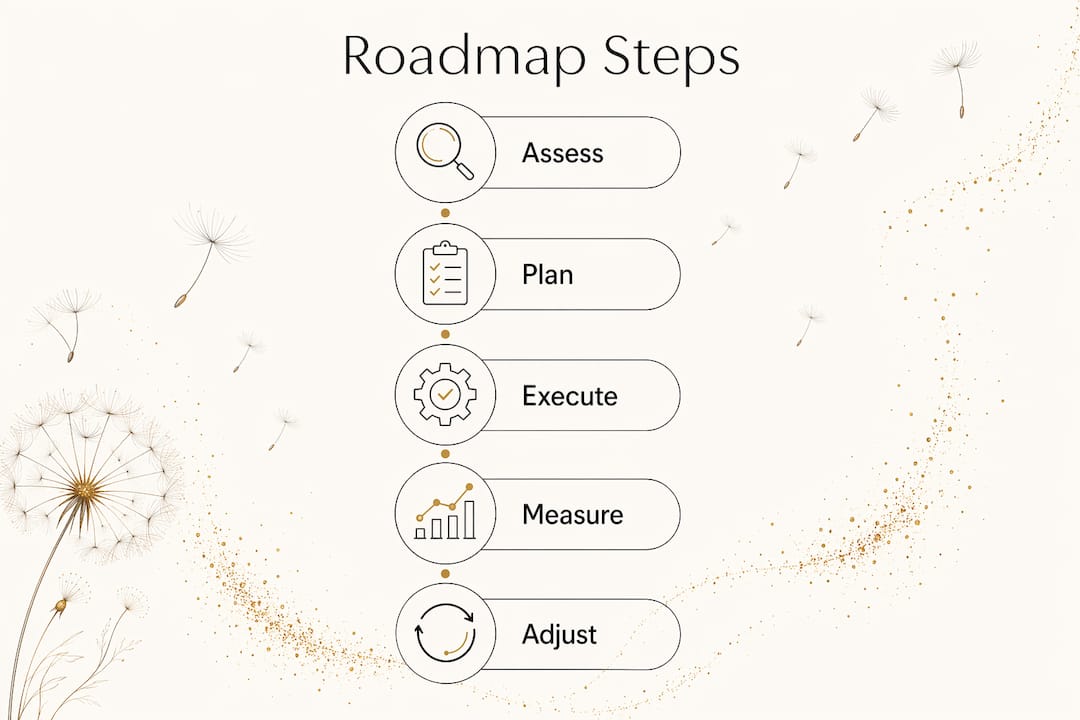
A well-built roadmap covers six distinct steps. Each one builds on the last. Skipping a step creates gaps that show up later as wasted budget or missed targets.
-
Assess your current digital presence. Audit your website, content, email list, and social channels. Note what’s working and what isn’t. Expanding your business requires revisiting your market analysis and competitive position before making any new moves. This step gives you the honest baseline you need.
-
Set clear, measurable objectives. Every goal on your roadmap needs a number attached to it. “Grow my email list” is not a goal. “Grow my email list from 400 to 1,200 subscribers by december 31” is a goal. Align each objective with a specific business outcome, such as revenue, leads, or customer retention.
-
Choose your digital channels using the SES framework. The SES framework focuses your digital marketing on three channels that do the heaviest lifting: Search, Email, and Social. Search drives discovery. Email nurtures and converts. Social builds awareness and community. Pick one primary tactic per pillar instead of spreading thin across every platform.
-
Allocate resources and assign owners. A roadmap without owners is just a document. Every initiative needs a person responsible for delivery and a realistic budget. Effective roadmaps include owners who remove blockers and report progress at review meetings. If you’re a solo operator, you are the owner of everything, so prioritize ruthlessly.
-
Build your timeline and map dependencies. Planning timelines for business expansions range from 2–4 weeks for simple moves to 1–3 months for complex ones. Financial projections should cover 12–24 months. Map which tasks must happen before others can start. Launching a content strategy before your website is search-ready, for example, wastes effort.
-
Set KPIs and a review cadence. Group your initiatives under strategic objectives rather than listing tasks. Then assign KPIs to each objective. Use monthly team reviews and quarterly leadership reviews to check progress and reprioritize as needed.
Pro Tip: Write your roadmap in a shared document with a version history. Every time you update it, note the date and the reason. This creates a record of your thinking and makes future planning faster.
Step summary: roadmap creation at a glance
| Step | Focus area | Output |
|---|---|---|
| 1. Assess | Current digital state | Baseline metrics report |
| 2. Set objectives | Business goals | Measurable targets with deadlines |
| 3. Choose channels | SES framework | One primary tactic per pillar |
| 4. Assign owners | Resources and accountability | Owner list with budgets |
| 5. Build timeline | Sequencing and dependencies | 12–24 month project plan |
| 6. Set KPIs | Measurement and review | Monthly and quarterly check-ins |
What mistakes should you avoid when implementing your roadmap?
Most roadmap failures come from the same handful of problems. Knowing them in advance saves you months of wasted effort.
- Channel fragmentation. Small businesses often manage many platforms shallowly instead of focusing on one primary play per SES pillar. The result is a lot of activity with very little traction. Pick your strongest channel per pillar and go deep before adding more.
- Overambition in the first quarter. A roadmap that tries to do everything in 90 days burns out teams and budgets. Sequence your initiatives so the foundational work, such as your website and email capture, comes first.
- No feedback loop. Executing without reviewing is the fastest way to waste a year. Build in a monthly check-in from day one, even if it’s just 30 minutes with yourself and your numbers.
- Ignoring resource constraints. Payback timelines for most small business expansions range from 2 to 4 years. Plan your cash flow accordingly and don’t commit to tactics that require sustained spend before you’ve validated the return.
Pro Tip: When you feel the urge to add a new channel or tactic, ask one question first: does this directly support one of my three SES pillars? If not, put it on a “later” list and revisit it at your next quarterly review.
Adding more digital channels without a focused strategy rarely improves results. Deliberate choices, not volume of activity, drive growth.
How do you measure success and adjust your roadmap over time?
A growth roadmap is not a static document. It’s a living plan that gets sharper as you gather real data. The measurement phase is where most small business owners either pull ahead or fall behind.
- Set KPIs that connect to revenue. Vanity metrics like page views and follower counts feel good but don’t pay bills. Track email list growth, lead conversion rate, cost per acquisition, and monthly recurring revenue instead.
- Use data to decide, not to confirm. If a channel is underperforming after 90 days of consistent effort, that’s a signal to adjust, not to push harder. Pivot the tactic, not the goal.
- Follow a structured review cadence. Monthly team reviews and quarterly leadership reviews keep the roadmap aligned with what’s actually happening in your business. Quarterly reviews are the right time to reprioritize initiatives or retire ones that aren’t working.
- Document every adjustment. When you change a tactic or shift a deadline, write down why. This builds institutional knowledge and makes your next roadmap significantly easier to build.
Successful digital transformation roadmaps align technology investments directly with business growth objectives. That alignment is what keeps your roadmap from becoming a list of disconnected projects.
Key Takeaways
A digital business growth roadmap works when it connects every digital initiative to a specific business outcome, assigns clear ownership, and gets reviewed on a regular schedule.
| Point | Details |
|---|---|
| Start with a baseline | Audit your website, email list, and search visibility before setting any goals. |
| Use the SES framework | Focus on Search, Email, and Social as your three core digital marketing pillars. |
| Assign owners and timelines | Every initiative needs a responsible person and a 12–24 month project timeline. |
| Protect your first-party data | Build every channel to capture CRM contacts and email subscribers you own. |
| Review and adjust regularly | Run monthly team check-ins and quarterly leadership reviews to stay on track. |
What I’ve learned from building digital roadmaps for small businesses
The biggest shift I’ve seen in working with small business owners is the moment they stop treating their digital presence as a collection of separate tasks and start treating it as a system. That shift changes everything.
Most entrepreneurs I talk to have tried at least three or four digital channels before they come to us. They’ve posted on Instagram, sent a few emails, maybe run some ads. But they’ve never connected those activities to a single, clear business outcome. The SES framework is the clearest way I’ve found to cut through that noise. Search, Email, Social. One primary play per pillar. That’s it.
The other thing I’d push back on is the idea that you need a perfect plan before you start. You don’t. You need a good enough plan with a built-in review process. The roadmap you have in month six will be far better than the one you started with. That’s not a failure. That’s how it’s supposed to work.
If I had to give one piece of advice to any entrepreneur building their first digital growth plan, it would be this: protect your email list like it’s your most valuable business asset. Because it is. Every other channel can change its algorithm, raise its ad rates, or disappear. Your email list stays with you.
— Christopher
How Moderatemurmurations helps you build and launch your digital presence
Moderatemurmurations builds the digital infrastructure that makes your roadmap real. We create fast, clean websites, SEO-ready content, brand copy, and AI-assisted workflows for small businesses, creators, and service providers who need to move quickly without cutting corners.

If you’ve mapped out your goals but need the technical foundation to support them, we can help you launch your business online in days, not months. Our build services cover everything from website structure and landing pages to digital systems designed for growth. We work with your plan, not against it. Reach out for a free consultation and we’ll show you exactly what your next step looks like.
FAQ
What is a digital business growth roadmap?
A digital business growth roadmap is a structured plan that aligns your digital marketing and technology initiatives with specific business growth goals. It includes objectives, owners, timelines, KPIs, and a review process.
How long does it take to create a growth roadmap?
Planning timelines range from 2–4 weeks for straightforward expansions to 1–3 months for more complex ones. Financial projections within the roadmap should cover 12–24 months.
What is the SES framework for digital marketing?
The SES framework organizes digital marketing into three core channels: Search, Email, and Social. Each pillar handles a different stage of the customer journey, from discovery to conversion to retention.
How often should you review your digital roadmap?
Monthly reviews at the team level and quarterly reviews at the leadership level are the recommended cadence. This keeps the roadmap current and allows for timely reprioritization.
What KPIs should a small business track on its roadmap?
Focus on KPIs tied to revenue and growth, such as email list size, lead conversion rate, cost per acquisition, and monthly recurring revenue. Avoid tracking vanity metrics like follower counts as primary indicators.