ChatGPT Consulting for Small Businesses: A Practical Guide
ChatGPT Consulting for Small Businesses: A Practical Guide

Hire a ChatGPT consultant who builds RAG-backed assistants, integrates them with your website and CRM, runs a measurable pilot, and hands over production-ready assets. That’s the short answer. The right engagement ends with a working system you own, not a slide deck you shelve.
Here’s what a solid pilot delivers:
- A working MVP assistant trained on your content and connected to your site
- A RAG pipeline that retrieves answers from your verified documents
- An integration spec for your CRM or helpdesk
- Defined success metrics and a go/no-go rule before scaling
- A handoff package: conversation flows, admin guide, and escalation paths
| Item | Details |
|---|---|
| Pilot timeline | 2–4 weeks for a small-business MVP |
| Typical pilot cost | a moderate fixed price |
| Production rollout | a variable cost depending on integrations |
| Recommended partner | Moderatemurmurations for website + CRM builds |
Moderatemurmurations works with small businesses, creators, and service providers on exactly this kind of pilot-to-production setup. More on that below.
Table of Contents
- What does ChatGPT consulting actually mean?
- What services does a ChatGPT consultant provide?
- When should you hire a ChatGPT consultant?
- How does a good ChatGPT consultant deliver results?
- How do you vet and choose a ChatGPT consultant?
- What does a ChatGPT consulting project cost and how long does it take?
- A mini workflow: adding a RAG assistant to your website and CRM
- Key Takeaways
- What we’ve learned building these systems for small businesses
- Ready to build your first AI assistant?
- Useful sources and further reading
What does ChatGPT consulting actually mean?
ChatGPT consulting is strategic and technical work that applies large language models, specifically OpenAI’s ChatGPT, to real business workflows through Retrieval-Augmented Generation (RAG), system connectors, and governance practices. It is not a one-hour Zoom call about prompts, and it is not a surface-level chatbot widget dropped onto your contact page.
The term “ChatGPT consulting” is widely used but loosely defined. The recognized industry term is conversational AI consulting, which covers the full scope: strategy, architecture, integration, and ongoing governance. Both terms appear throughout this guide.
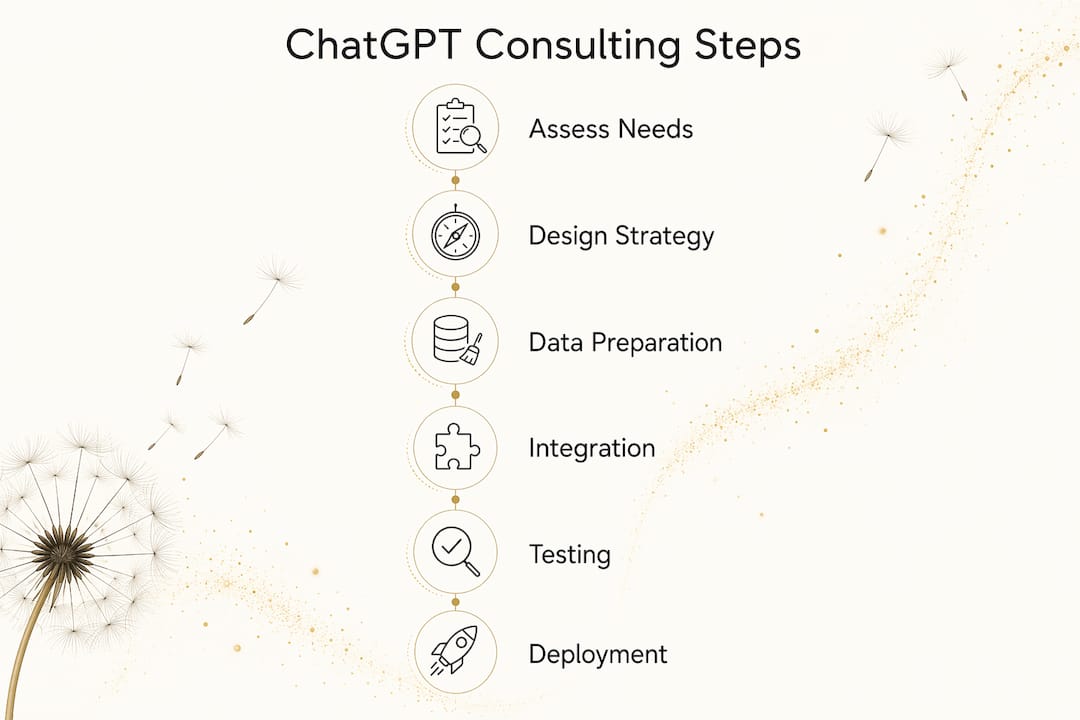
What separates real consulting from a chatbot install is the outcome. A consultant designs a system that automates real business tasks by connecting an AI assistant to your internal data, your CRM, and your customer-facing channels. The goal is proof-of-value pilots that show measurable results before you commit to a full production build.
What services does a ChatGPT consultant provide?
A well-scoped engagement covers the full path from discovery to handoff. Expect these services:
- Discovery and use-case mapping: Identify which workflows are worth automating and define success metrics upfront
- Pilot and MVP design: Scope a small, testable experiment with a clear go/no-go rule
- RAG data ingestion: Collect, clean, and chunk your documents into a vector database
- Prompt engineering: Design and test prompt chains that produce reliable, on-brand responses
- API and web widget integration: Connect the assistant to your website or app via API
- CRM, ERP, and helpdesk connectors: Wire the assistant into HubSpot, Salesforce, Zendesk, or similar tools
- Analytics and monitoring: Set up dashboards to track automation rate, accuracy, and escalation volume
- Training and playbooks: Equip your team to manage, update, and expand the system
Each service maps to a tangible deliverable. RAG ingestion produces a vector database and a chunking spec. Integration work produces an API configuration and a connector map. Training produces an admin playbook and an acceptable-use policy. The AI literacy your team builds during handoff is what keeps the system running after the consultant leaves.
Service boundaries matter. Strategy and architecture are consulting. Building and deploying is implementation. Ongoing tuning, content refresh, and monitoring are managed support. Know which you’re buying.

When should you hire a ChatGPT consultant?
Hire when you need reliable automation tied to a specific business outcome: reducing support load, qualifying leads faster, summarizing customer notes, or removing repetitive tasks from your team’s plate.
Specific signs it’s time:
- Your team spends hours each week answering the same customer questions
- Website conversion is stalling because visitors can’t find answers quickly
- You have no internal engineering capacity to build or maintain AI integrations
- Messaging is inconsistent across channels because there’s no single source of truth
For small businesses and creators, the highest-value starting points are a website assistant with lead capture, CRM enrichment from conversation data, and content repurposing pipelines. These are contained, measurable, and fast to launch.
Before committing to a full build, run a low-cost experiment. Load a few documents into a free RAG tool, write five test prompts, and measure how often the answers are accurate and on-brand. That 30-minute test tells you more about your data readiness than any vendor pitch. The AI adoption guide for small businesses walks through exactly this kind of scoped starting point.
How does a good ChatGPT consultant deliver results?
The standard delivery process moves through five phases: discovery, pilot (MVP), validation, production, and governance. Each phase has a clear output and a decision point before the next begins.
- Discovery: Map workflows, audit existing data, define success metrics, and set a go/no-go rule for the pilot
- Data preparation: Collect internal documents, chunk them into 512–1,024 token segments, and index them in a vector database
- Retrieval tuning: Test retrieval strategies to confirm the assistant surfaces the right documents for each query type
- Prompt engineering: Build and test prompt chains, including fallback responses and escalation triggers
- Integration: Connect the assistant to your website widget, CRM, or helpdesk via API
- Validation: Run the pilot against real queries, measure accuracy and automation rate, and apply the go/no-go rule
- Production handoff: Deploy, document, and train your team on the live system
- Governance: Establish ongoing monitoring, content refresh cycles, and an acceptable-use policy
Anti-hallucination requirements
RAG grounding is the single most important technical safeguard. It ensures every response is retrieved from your verified documents rather than generated from the model’s general training. Beyond RAG, require confidence thresholds so the assistant routes low-confidence queries to a human agent, explicit “I don’t know” responses when a query falls outside scope, and source citations so users can verify answers.
Security checklist
- Define data scope: only ingest documents the assistant is authorized to use
- Handle PII carefully: mask or exclude customer data from training sets
- Manage API keys with environment variables, never hardcoded
- Apply minimal data retention: don’t store conversation logs longer than necessary
Pro Tip: Set one experiment-level success metric before the pilot starts, such as “automate 50% of FAQ queries with 90% accuracy,” and write a clear go/no-go rule. If the pilot doesn’t hit it, fix the data before scaling, not after.
How do you vet and choose a ChatGPT consultant?
Pick consultants who can show you a working RAG implementation, name the CRMs they’ve integrated, and describe the metrics they used to validate a past pilot. That combination separates practitioners from presenters.
Questions worth asking:
- Can you walk me through a RAG pipeline you’ve built and the accuracy it achieved?
- How do you handle queries that fall outside the assistant’s knowledge scope?
- What does your go/no-go rule look like for a pilot?
- Who owns the vector database, the prompt configurations, and the conversation logs after handoff?
- How do you manage PII and data retention?
Red flags to watch for: vague success metrics (“it’ll improve customer experience”), no mention of RAG or confidence thresholds, promises of perfect accuracy, missing escalation workflows, and unclear IP ownership. A consultant who can’t explain their AI strategy in plain terms probably doesn’t have one.
Contract checklist: defined deliverables with acceptance tests, a data ingestion scope, a pricing model (fixed pilot vs. project vs. monthly support), maintenance terms, and a clear termination clause that transfers all assets to you.
What does a ChatGPT consulting project cost and how long does it take?
| Engagement type | Typical price band | Timeline | What’s included |
|---|---|---|---|
| Fixed-price pilot | — | 2–4 weeks | MVP assistant, RAG setup, basic widget, success metrics |
| Production project | — | 4–8 weeks | Full integration, CRM connectors, admin dashboard, playbook |
| Monthly support | an ongoing fee | Tuning, content refresh, monitoring, escalation review |
Basic RAG implementations and standard web widget chatbots can typically launch in 2–3 weeks. Enterprise multi-channel builds take longer depending on integration complexity.
The main cost drivers are data preparation time, connector complexity, multi-channel deployment, SLA requirements, and ongoing vector database and API costs. One often-overlooked optimization: Caching frequent API responses can reduce operational API costs by roughly 40–60% for custom AI solutions.
A monthly support arrangement makes sense once the assistant is live and handling real traffic. Continuous tuning, analytics review, and content refresh keep accuracy high as your business evolves.
A mini workflow: adding a RAG assistant to your website and CRM
The goal: a website assistant that resolves common queries, captures leads, and writes structured notes directly into your CRM.
- Discovery: Audit your top 20 customer questions and map them to existing content
- Data preparation: Export FAQs, service pages, and policy docs; chunk into 512–1,024 token segments
- Vector DB setup: Index chunks in a vector database (Pinecone, Weaviate, or similar)
- Retrieval tuning: Test retrieval against the 20 questions; adjust chunk size and metadata filters
- Prompt engineering: Write a system prompt that defines tone, scope, and fallback behavior
- Widget integration: Embed the assistant on your site via a JavaScript snippet or API connection
- CRM connector: Configure a webhook or native integration to push lead data and conversation summaries to your CRM
- Testing and training: Run 50 test conversations, measure accuracy, and brief your team on the admin dashboard
- Launch: Go live with monitoring active; review escalation logs weekly for the first month
Expected outcomes: conversational AI implementations can automate 60–80% of routine customer contacts when properly scoped and integrated. With proper RAG and dataset curation, assistants can achieve 85–95% accuracy on in-scope queries. Track automation rate, customer satisfaction score (CSAT), and lead-to-client conversion rate as your primary KPIs. A well-designed consultant website paired with a live assistant compounds those conversion gains.
Key Takeaways
Effective ChatGPT consulting requires RAG grounding, measurable pilots, clear data governance, and a 2–6 week timeline before you scale anything.
| Point | Details |
|---|---|
| Prioritize RAG | Require RAG grounding in every production assistant to reduce hallucinations and improve accuracy. |
| Run a measurable pilot | Set a go/no-go metric before the pilot starts; don’t scale until the MVP hits it. |
| Protect your data | Define data scope, manage PII carefully, and confirm IP ownership before signing a contract. |
| Expect a 2–4 week pilot | Basic RAG assistants and web widgets launch in 2–3 weeks; production builds run 4–6 weeks. |
| Moderatemurmurations | Offers pilot-to-production website and CRM integrations for small businesses, creators, and service providers. |
What we’ve learned building these systems for small businesses
The biggest mistake we see isn’t choosing the wrong tool. It’s scaling before the pilot proves anything. Successful AI adoption requires defined success metrics, clear go/no-go criteria, and experiments that prove a business case before you invest in a full production build. Enthusiasm is not a strategy.
There’s also a persistent myth that RAG is only for enterprise teams with large engineering budgets. It isn’t. A small-business RAG pipeline built on a clean FAQ document and a modest vector database can outperform a much more expensive custom model trained on messy data. Data quality beats model complexity almost every time.
The other thing worth saying plainly: the consultant’s job is to hand you something you own and can run. If the engagement ends with you dependent on the vendor to make any change, the handoff failed. Ask for the vector database, the prompt configurations, the integration specs, and the admin playbook. They’re yours.
For creators and service providers, the website-plus-CRM integration is the highest-leverage starting point. It captures leads, answers questions around the clock, and writes structured notes into your pipeline without adding headcount. That’s a real, measurable return on a contained investment.
Ready to build your first AI assistant?
Moderatemurmurations builds pilot-to-production AI assistants for small businesses, creators, and service providers, starting with your website and CRM. Our process is straightforward: a scoped discovery call, a fixed-price pilot with clear success metrics, and a clean handoff with everything documented.
What’s included in a pilot: RAG pipeline setup, web widget integration, CRM connector configuration, conversation flow design, and an admin playbook your team can run from day one. Most pilots launch within 2–4 weeks.
No open-ended retainers to start. You get a working system, the assets, and the documentation. If you want ongoing support after that, we offer it, but the pilot stands on its own.
Book a free strategy call and tell us what you’re trying to automate. We’ll tell you honestly whether a pilot makes sense and what it would take to build it.
Useful sources and further reading
For technical implementation, the ChatGPT integration guide from Benai covers chunking strategies, caching, and API cost optimization in practical detail. It’s the best starting point for anyone preparing data for a RAG pipeline.
For methodology and pilot design, AI Strategies Consulting outlines how to move from experimentation to production with structured pilots and vendor-neutral architecture evaluation. Useful for anyone evaluating consultant approaches.
For end-to-end integration scope, Geniusee’s conversational AI consulting overview explains how CRM, ERP, and helpdesk connectors fit into a full workflow automation engagement.
For accuracy benchmarks and RAG architecture, AHK.AI’s enterprise chatbot development guide covers confidence thresholds, escalation design, and realistic accuracy targets for in-scope queries.
For vendor selection and AI strategy planning, Sentient Concepts’ guide to crafting effective AI strategies with consultants is a practical resource for evaluating consultant fit and building a strategy that holds up past the pilot phase.