The Role of Blogging for Visibility in Small Business
The Role of Blogging for Visibility in Small Business

Blogging is the most reliable method a small business has for building sustained online visibility without depending on rented platforms. Unlike social media posts that vanish within hours, a well-written blog post continues attracting search traffic for years. HubSpot data shows that marketers who prioritize blogging are 13 times more likely to see positive marketing ROI. That number reflects a simple truth: content you own compounds over time, while content you post on Instagram or Facebook disappears into an algorithm you do not control. The role of blogging for visibility is not just about traffic. It is about building credibility, authority, and a permanent digital foundation.
How does blogging increase online visibility compared to other content types?
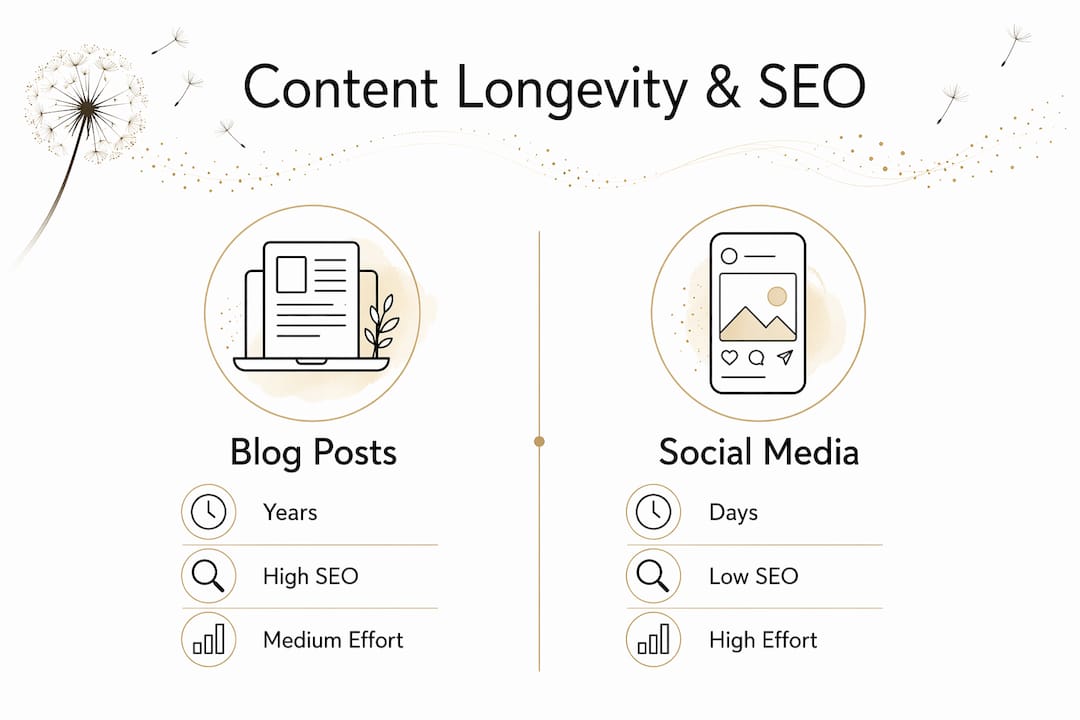
Blogging creates evergreen content, meaning a single post can rank in Google, appear in AI tools like ChatGPT and Gemini, and generate leads for years after publication. A social media post, by contrast, has a lifespan measured in hours. Video content performs well for engagement but requires significant production effort and rarely ranks for long-tail search queries the way a detailed blog post does.
The SEO advantage is concrete. Websites with active blogs have 434% more indexed pages and generate 67% more leads than sites without blogs. More indexed pages means more entry points for search engines and AI tools to find and cite your business. Each post you publish is another door into your website.

Here is how blogging compares directly to other content formats:
| Content type | Longevity | SEO benefit | Effort required |
|---|---|---|---|
| Blog post | Years | High | Medium |
| Social media post | Hours to days | Very low | Low |
| Video | Months | Medium | High |
| Email newsletter | Days | None | Medium |
Blogging also feeds every other channel. A single post gives you material for email newsletters, social media captions, and sales conversations. Blogging acts as the foundation of your marketing mix, supplying depth and substance that prevents surface-level engagement across all your channels.
Pro Tip: Write your blog post first, then extract three to five social media captions and one email newsletter section from it. One piece of content becomes a week of marketing material.
What are the best practices for small business blogging?
Small business owners often assume blogging requires hours every week. It does not. Maintaining an effective blog takes as little as 1–2 hours every two weeks when you work with a clear process. The key is batching: write, edit, and schedule multiple posts in one focused session rather than starting from scratch each time.
Quality beats quantity every time. One well-researched post per month outperforms four thin, rushed posts. Search engines and readers both reward depth, specificity, and genuine usefulness. A post that fully answers a question your customer is already searching for will outrank a post that skims the surface.
Follow these practices to keep your blog consistent without burning out:
- Pick a realistic schedule. One post per month is enough to start building momentum.
- Use a content calendar. Plan topics three months ahead so you never face a blank page.
- Align topics with search intent. Use Google Search Console or a tool like Semrush to find what your audience is already searching for.
- Edit with tools like Grammarly or Hemingway Editor. Both catch clarity issues and improve readability without requiring a professional editor.
- Batch and schedule. Tools like PostOnce let you write posts in advance and publish on a set schedule.
Avoid the trap of writing about what interests you rather than what your audience searches for. Every post should answer a specific question or solve a specific problem your customer has right now.
Pro Tip: Keep a running list of questions customers ask you by email, phone, or in person. Each question is a blog post topic. This method never runs dry and guarantees search relevance.
How does blogging support SEO and other marketing channels?
Blogging and SEO are not separate strategies. They work together. Every blog post you publish is an opportunity to target a specific keyword, earn backlinks from other sites, and build internal links that strengthen your entire website. Blog SEO tactics including keyword research, internal linking, and backlink attraction increase your chances of ranking for multiple search queries simultaneously.
Here is how to apply SEO principles to each post you write:
- Choose one primary keyword per post. Target a phrase your audience actually searches for, not industry jargon.
- Use the keyword in your title, first paragraph, and at least one subheading. Do not force it. Natural placement outperforms keyword stuffing.
- Link to two or three related posts on your site. Internal links help Google understand your site structure and keep readers engaged longer.
- Write a clear meta description. This is the text that appears under your title in search results. Make it specific and direct.
- Earn backlinks by writing posts worth citing. Original data, detailed guides, and expert opinions attract links from other websites naturally.
Blogging also builds what Google calls topical authority. When you publish multiple posts on related subjects, Google recognizes your site as a credible source on that topic. Over time, consistent blogging builds recognized entities in Google’s Knowledge Graph, which increases your chances of appearing in AI-generated answers and featured snippets.
The compounding effect is real. The real momentum from blogging builds after publishing 50–100 posts, when internal linking, domain authority, and backlinks reinforce each other. That is a long-term play, but it is one that social media can never replicate.
Pro Tip: Consult a resource like Kicker Video’s guide on blogging your expertise for practical frameworks on positioning your blog as a professional visibility tool, especially if you run a service-based business.
What challenges do small business owners face with blogging for visibility?
The biggest misconception about blogging is that it is primarily a traffic tool. Traffic is a byproduct. The real function of a blog is to build credibility and give your marketing mix a foundation of substance. Without it, your social posts, emails, and sales conversations stay shallow and forgettable.
Consistency is the hardest part. Most small business owners start a blog with energy, publish three or four posts, then stop when results do not appear immediately. Commit to at least 6 months before evaluating whether blogging is working. SEO and content authority take time to develop. Stopping early means you never reach the compounding phase where the real returns appear.
Common challenges and how to address them:
- Writer’s block. Return to your customer question list. If that runs dry, read industry forums, Reddit threads, or competitor FAQ pages for topic ideas.
- Content fatigue. Reduce your publishing frequency before you quit entirely. One post every six weeks beats zero posts.
- No visible results in the first three months. Track keyword rankings in Google Search Console rather than traffic alone. Rankings improve before traffic spikes.
- Inconsistent brand voice. Create a one-page style guide covering your tone, vocabulary, and audience. Share it with anyone who writes for your blog.
Businesses that ignore blogging rent their visibility on social platforms they do not own. Algorithm changes, platform shutdowns, or account restrictions can erase years of social media work overnight. A blog you own and host cannot be taken away.
Pro Tip: Set a recurring calendar reminder every two weeks labeled “Blog Day.” Treat it like a client meeting. Protecting that time is the single most effective way to stay consistent.
Key Takeaways
Blogging builds long-term visibility by creating owned, evergreen content that compounds in SEO value, topical authority, and lead generation over time.
| Point | Details |
|---|---|
| Blogging outperforms social media | Blog posts generate leads and rank in search for years; social posts disappear within hours. |
| Quality beats frequency | One well-researched post per month delivers more SEO value than multiple thin posts. |
| Blogging feeds all channels | A single post supplies material for email, social media, and sales conversations. |
| Commit to six months minimum | Compounding SEO and authority benefits take time; early results are rankings, not traffic. |
| Own your content library | Blogs survive algorithm changes; social platforms can remove your visibility overnight. |
Why I think blogging is the most underrated asset a small business owns
Most small business owners treat blogging as optional. I think that is a mistake. After working with dozens of entrepreneurs on their digital presence, the pattern is clear: the businesses with active, consistent blogs are the ones that show up in search, get cited by AI tools, and convert visitors into clients at a higher rate.
The businesses without blogs are entirely dependent on social media platforms they do not control. One algorithm change and their visibility drops. One platform policy shift and their audience disappears. A blog is the one digital asset that stays yours.
The time objection is real but solvable. You do not need to publish weekly. You need to publish consistently and with purpose. A single post that genuinely answers a question your customer is searching for will outwork a dozen social posts in six months. The math is not close.
My honest advice: start with one post per month, write it around a real question your customers ask, and commit to that schedule for six months before judging the results. The compounding effect is not a theory. It is what happens when you build something you own.
— Christopher
Build your online presence with Moderatemurmurations
Blogging works best when it sits inside a well-structured website with clear messaging and search-friendly architecture. Without that foundation, even great content underperforms.

Moderatemurmurations builds fast, clean websites, SEO content, and digital systems for small businesses and service providers. We help you launch with the right structure so your blog posts actually get found. From AI-assisted content workflows to full website and digital infrastructure, we handle the technical side so you can focus on your business. Ready to turn your expertise into a visible, credible online presence? Start building today with a team that understands what small businesses actually need.
FAQ
What is the role of blogging for visibility?
Blogging builds long-term online visibility by creating evergreen content that ranks in search engines and AI tools. It establishes credibility and attracts organic traffic without relying on paid ads or social media algorithms.
How often should a small business publish blog posts?
One well-researched post per month is enough to build momentum. Consistency matters more than frequency, and committing to at least six months gives SEO benefits time to compound.
Does blogging still work for SEO in 2026?
Yes. Websites with active blogs have 434% more indexed pages and generate 67% more leads than sites without blogs. Blog content also appears in AI-generated answers from tools like ChatGPT and Gemini.
How does blogging support other marketing channels?
A single blog post supplies material for email newsletters, social media captions, and sales conversations. Blogging acts as the content foundation that gives every other channel depth and consistency.
How long does it take to see results from blogging?
Most businesses see meaningful SEO results after six months of consistent publishing. The compounding effect from internal linking, backlinks, and domain authority builds significantly after 50–100 published posts.