Online Visibility Checklist for Entrepreneurs: 2026 Guide
Online Visibility Checklist for Entrepreneurs: 2026 Guide

An effective online visibility checklist for entrepreneurs is defined as a structured audit covering three measurable layers: search visibility (SEO), AI visibility, and trust visibility (social proof and conversion signals). Most entrepreneurs focus only on one layer and wonder why their website generates no leads. Treating all three as a unified system, using tools like Google Business Profile, Ahrefs, and schema markup, is what separates businesses that get found from those that stay invisible. This guide gives you a practical digital presence guide built for 2026, where AI-powered search has changed the rules.
1. Audit your current search visibility first
The first step in any visibility checklist for online branding is knowing where you actually stand. Search your brand name, your founder name plus your company name, and the core problem your product solves. These three search types reveal gaps that a single branded search will never show you. SavageAudit’s 2026 checklist structures this exact approach into a repeatable audit framework.
What you find in those searches tells you whether your positioning is clear or muddled. If a competitor appears when someone searches the problem you solve, your content is not doing its job. Document every gap you find before making changes.

2. Optimize your website’s technical SEO foundations
Technical SEO is the floor your entire online presence stands on. Your site must be indexed by Google, load quickly, and carry accurate title tags and meta descriptions on every page. A page that loads slowly or fails mobile tests will not rank, regardless of how good the content is.
Run your site through Google Search Console to confirm indexing status. Check that every page has a unique title tag and that none are missing or duplicated. Page speed under roughly 3 seconds is a conversion trust standard, not just a ranking factor. Slow pages lose visitors before they ever read a word.
Pro Tip: Use Google Search Console’s Coverage report monthly to catch crawl errors before they compound into ranking losses.
3. Set up and optimize your Google Business Profile
Google Business Profile (GBP) is the single most important local visibility tool for entrepreneurs serving a geographic area. Precise primary category selection and up to 9 relevant secondary categories directly affect which searches your listing appears in. Upload 25–30 optimized photos and post an update every 7 days to signal an active, trustworthy business.
One critical mistake to avoid: never add keywords or city names inside your business name field. Keyword stuffing in your GBP name can misclassify your listing and trigger ranking penalties. Keep your business name exactly as it appears on your legal documents and let your categories do the ranking work.
4. Implement LocalBusiness schema markup
Schema markup is structured data that tells search engines exactly what your business is and where it operates. LocalBusiness schema in JSON-LD format requires fields including business type, name, address, phone number, geo-coordinates, hours, and URL. Getting these fields right qualifies your listing for rich results in Google Search.
Use specific subtypes within the LocalBusiness schema rather than the generic parent type. A yoga studio should use HealthClub or SportsActivityLocation, not just LocalBusiness. After implementing, validate your markup with Google’s Rich Results Test tool. Errors in JSON-LD are common and will silently break your local SEO enhancements if left unchecked.
5. Build AI visibility through brand mentions
AI visibility is the measure of how often AI tools like ChatGPT, Perplexity, and Google’s AI Overviews cite your brand when answering relevant questions. Ahrefs analyzed 75,000 brands and found that brand mentions correlate with AI visibility at a rate of 0.66–0.74, stronger than traditional metrics like domain rating or backlinks. That finding changes where entrepreneurs should invest their time.
YouTube mentions and general web mentions lead all channels in driving AI citation rates. Getting featured on podcasts, quoted in industry articles, and reviewed on third-party platforms all build the mention footprint that AI tools draw from. This is not optional for entrepreneurs who want to appear in AI-generated answers.
- Get featured on relevant podcasts in your niche
- Publish guest posts on established industry blogs
- Create YouTube content that answers specific buyer questions
- Encourage customers to mention your brand in public reviews
- Build a Wikipedia or Wikidata presence if your brand qualifies
Pro Tip: Search your brand name in ChatGPT and Perplexity monthly. If you do not appear in answers to questions you should own, your brand mention strategy needs more channels.
6. Track AI visibility share of voice
AI visibility share of voice measures how often your brand is cited in AI tools compared to your direct competitors. Brand Radar tracks this KPI specifically for entrepreneurs who want to measure their marketing impact on AI-driven discovery. Without tracking, you cannot tell whether your brand mention efforts are working.
Set a baseline measurement now. Run the same 5–10 buyer questions through ChatGPT and Perplexity and record which brands appear. Repeat this monthly. The goal is to see your brand appear more frequently over time as your mention footprint grows across YouTube, podcasts, and the broader web.
7. Add social proof that converts visitors into clients
Social proof is the collection of signals that tell a new visitor your business is real, credible, and worth trusting. Conversion trust checklist items include testimonials, star ratings, case study snippets, and visible client logos. These elements reduce the hesitation a first-time visitor feels before contacting you.
Place testimonials on your homepage, service pages, and contact page. Do not hide them in a dedicated “reviews” tab that most visitors never click. A single strong testimonial near your main call to action does more work than a full page of reviews buried in the navigation.
- Display Google or Yelp star ratings on your website
- Add 2–3 short client testimonials above the fold on key pages
- Show certifications, awards, or media mentions in a trust bar
- Include a clear privacy policy and visible contact information
- Link to your Google Business Profile reviews from your site
8. Confirm your site’s conversion fundamentals
Visibility without conversion is wasted traffic. Your site needs an SSL certificate (the padlock in the browser bar), a mobile-friendly layout, and working links throughout. Mobile-friendly design and SSL are baseline requirements for both Google rankings and visitor trust in 2026.
Check every call to action on your site. Each page should have one clear next step: book a call, download a guide, or send a message. Multiple competing CTAs on one page reduce conversion rates. Pick one primary action per page and make it obvious.
9. Build and grow your email list
An email list is the one digital asset you own outright. Social platforms change algorithms and reduce reach, but your email list stays yours. Set up a simple opt-in offer, a checklist, a free guide, or a short email course, and place it on your homepage and blog posts.
Use a platform like Mailchimp or ConvertKit to manage subscribers and send consistent newsletters. A monthly email keeps your brand in front of warm leads who are not yet ready to buy. That consistent contact is what turns a visitor into a client over time.
10. Establish a regular visibility audit cadence
A one-time audit fixes today’s problems but not next quarter’s. Scheduling routine audits and documenting results is what keeps your online presence competitive as algorithms and buyer behavior shift. Build a simple calendar reminder for each layer.
A practical audit schedule looks like this:
- Weekly: Post a GBP update, respond to new reviews, check for broken links
- Monthly: Review Google Search Console for crawl errors, run AI visibility spot checks, update any outdated page content
- Quarterly: Refresh GBP photos, audit schema markup for accuracy, review title tags and meta descriptions across key pages
- Annually: Full three-layer audit covering SEO, AI visibility, and trust signals with documented benchmarks
Profiles that upload fresh photos every 2 weeks and post regularly stay competitive in local search. Dormant profiles lose ranking potential over time, even if they were well-optimized at launch.
11. Clarify your positioning for the right buyers
Founder visibility in 2026 favors clear, unambiguous positioning over broad awareness. Your homepage, GBP description, and social bios should all answer the same two questions: who you help and what problem you solve. Vague positioning confuses both buyers and search algorithms.
Review your key digital assets and ask whether a first-time visitor can identify your ideal client within 5 seconds. If the answer is no, rewrite the headline. Clarity in positioning is a visibility strategy for startups that costs nothing but pays off in better-qualified traffic.
Key takeaways
A complete online visibility checklist for entrepreneurs requires SEO, AI visibility, and trust signals working together as one system, not three separate tasks.
| Point | Details |
|---|---|
| Three-layer system | Audit SEO, AI visibility, and trust signals together for full digital presence coverage. |
| GBP is non-negotiable | Optimize categories, photos, and posts weekly to maintain local search ranking. |
| Brand mentions drive AI citations | Build mentions across YouTube, podcasts, and web to appear in AI-generated answers. |
| Social proof converts traffic | Place testimonials and reviews near calls to action, not buried in a separate tab. |
| Audit on a schedule | Weekly, monthly, quarterly, and annual checks keep your visibility from going stale. |
What I have learned from running visibility audits
Most entrepreneurs I work with have the same problem. They have a website, a Google Business Profile, and a few social accounts, and they assume that is enough. The audit almost always reveals the same gap: the three layers are not connected. The website has no schema markup. The GBP has not been updated in months. And the brand has zero presence in AI-generated answers.
The insight that changed how I approach this work came from looking at AI visibility data. Brand mentions matter more for AI citation rates than backlinks or domain authority. That is a real shift from how SEO worked five years ago. Entrepreneurs who are still only chasing backlinks are building for a search environment that is already changing.
The other thing I see constantly is vague positioning. A homepage that says “I help businesses grow” tells no one anything. Clarity about who you serve and what specific problem you solve is what makes the right buyer stop scrolling and read. Specificity is not limiting. It is what makes you findable.
My honest advice: do the audit before you create more content. Most entrepreneurs need to fix what exists before adding more. A well-structured, clearly positioned, technically sound site with 10 pages will outperform a bloated site with 100 unfocused ones. Start with the checklist. Fix the gaps. Then build.
— Christopher
How Moderatemurmurations helps entrepreneurs get found faster
Moderatemurmurations builds fast, clean websites, brand copy, and digital systems specifically for entrepreneurs who need a polished online presence without months of back-and-forth. Every project includes search-friendly structure, clear messaging, and the technical foundations this checklist covers.
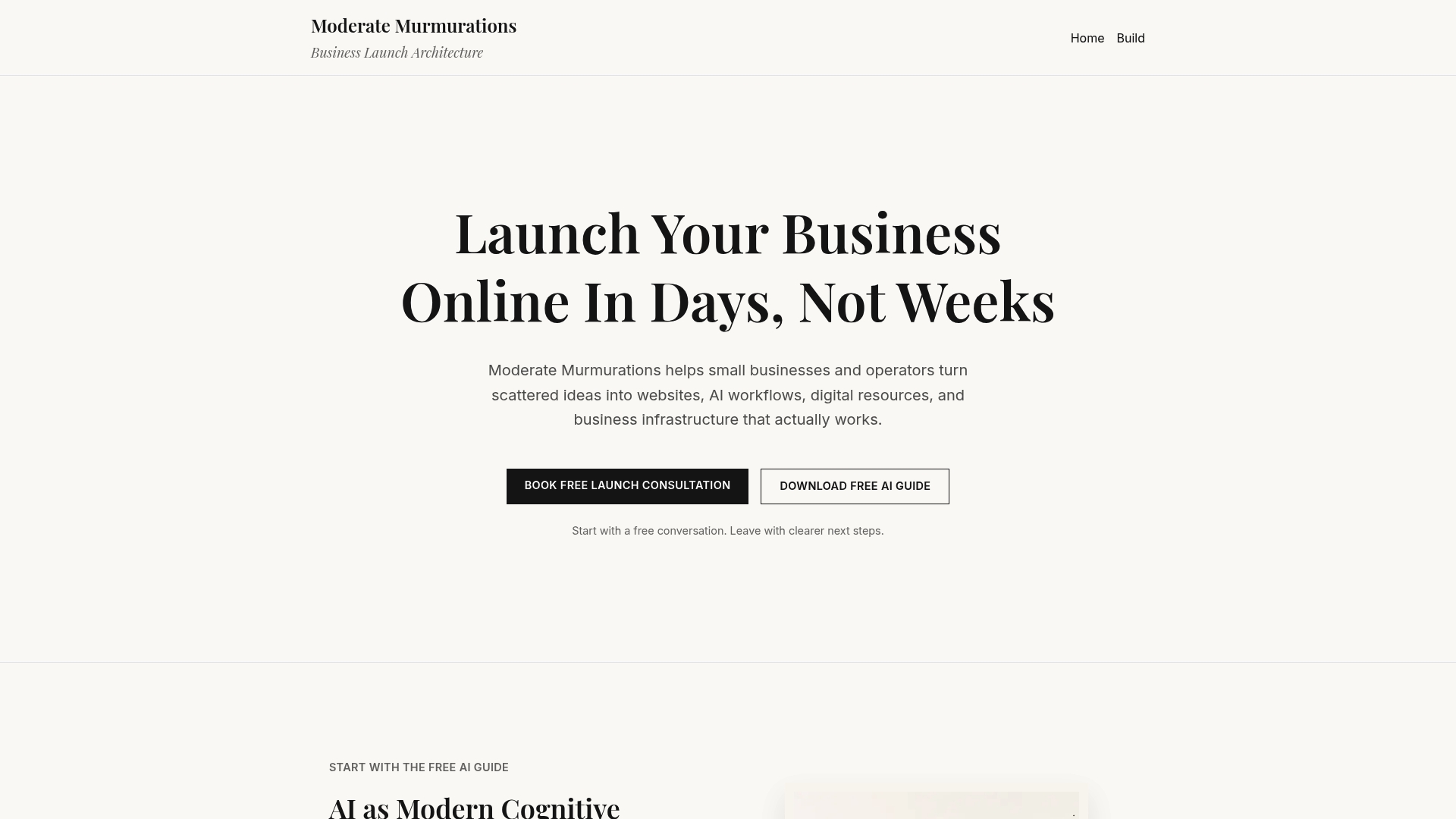
If your current site is missing schema markup, has no clear call to action, or simply does not reflect the quality of your work, Moderatemurmurations can fix that quickly. Launch your business online with a site built to be found, trusted, and converted from day one. For entrepreneurs ready to go further, the Build page covers website launch, AI workflow setup, and full digital infrastructure tailored to your goals.
FAQ
What are the three layers of an online visibility checklist?
An online visibility checklist covers search visibility (SEO), AI visibility (brand mentions and AI citations), and trust visibility (social proof and conversion signals). Each layer addresses a different stage of how buyers find and evaluate your business.
How does Google Business Profile affect local visibility?
Google Business Profile directly controls whether your business appears in local map results and Google Search. Accurate categories, regular posts, fresh photos, and active review responses all signal to Google that your profile is trustworthy and current.
Why do brand mentions matter more than backlinks for AI search?
Ahrefs research on 75,000 brands shows brand mentions correlate with AI visibility at 0.66–0.74, outperforming traditional metrics like domain rating. AI tools draw from the broader web of mentions, not just link graphs.
How often should entrepreneurs audit their online visibility?
A practical cadence includes weekly GBP updates, monthly Search Console checks, quarterly schema and content reviews, and a full annual audit. Consistent maintenance prevents gradual ranking loss from stale or outdated information.
What is AI visibility share of voice?
AI visibility share of voice measures how frequently your brand appears in AI-generated answers compared to competitors. Tracking this metric monthly across tools like ChatGPT and Perplexity shows whether your brand mention strategy is gaining ground.