Entrepreneur Personal Brand Website Examples for 2026
Entrepreneur Personal Brand Website Examples for 2026

A personal brand website is a digital platform that showcases an individual entrepreneur’s unique value, personality, and expertise to attract clients, collaborators, and opportunities. Unlike a standard business site, it centers entirely on one person’s story, skills, and credibility. The best entrepreneur personal brand website examples in 2026 share three consistent traits: a clear About section, curated portfolio work, and strategic lead capture. Knowing what those sites do well gives you a direct blueprint to build your own.
What makes great entrepreneur personal brand website examples
The strongest personal brand sites share a predictable structure. Top 2026 examples consistently include an About/Bio section, portfolio, testimonials, and visual consistency that matches the entrepreneur’s personality. That structure is not accidental. It reflects what visitors actually need to decide whether to trust and hire someone.
Here are the core elements found across the best entrepreneur websites:
- About/Bio section: Communicates your unique selling proposition and personality in plain language. Visitors decide within seconds whether you are relevant to them.
- Portfolio or project showcase: Acts as evidence backing your claims. Portfolios work best when they highlight your top three projects on the homepage and push full details to dedicated project pages, reducing decision fatigue.
- High-quality profile photography: Creates an immediate personal connection. A professional headshot signals credibility before a visitor reads a single word.
- Testimonials and social proof: Shift the burden of proof from you to your clients. One specific, results-focused testimonial outperforms five generic ones.
- Consistent visual design: Color, font, and copy style must match your brand personality. Inconsistency signals a lack of attention to detail.
- Clear navigation and CTAs: Navigation structure must help visitors find your portfolio, story, and contact path without hunting.
Pro Tip: Write your About section headline as a one-sentence value statement. “I help B2B founders close more deals with cleaner messaging” beats “Welcome to my website” every time.
How successful entrepreneur sites capture leads and grow their audience

Lead capture is where most personal brand sites leave money on the table. A visitor who leaves without giving you their email is gone. Lead magnets accelerate list growth when they are immediately accessible and directly relevant to the visitor’s problem.
Common lead magnet formats that work well for entrepreneurs include:
- Ebooks and short guides: Best for thought leaders who want to demonstrate depth on a specific topic.
- Templates and planners: High perceived value and low production cost. A one-page business plan template or a weekly content calendar converts well.
- Inspiration files and swipe files: Popular with creative entrepreneurs and designers.
- Mini email courses: Deliver value over several days and build familiarity before a sales conversation.
Placement matters as much as format. Exit-intent popups, welcome popups, embedded forms within blog posts, and sticky header bars each serve different visitor behaviors. Lead magnet performance depends more on relevance and immediate delivery after opt-in than on novelty. The moment someone subscribes, they should receive exactly what was promised, with a clear next step.
Lead capture works best when it is designed as the start of a guided relationship, not a one-time email grab. Build a short welcome sequence that delivers value, introduces your work, and points toward a consultation or product.
Pro Tip: Keep your opt-in form to two fields maximum: first name and email. Every additional field reduces conversion. You can collect more information later.
Standout entrepreneur personal brand website examples and what they do right
The best personal brand sites are bold, authentic, clear, and designed to convert visitors without feeling generic. Each example below illustrates a specific principle you can apply directly.
1. The clarity-first consultant
This type of site leads with a single headline that names the problem solved and the audience served. No hero video, no animation. Just a direct statement, a professional photo, and two CTAs: “See my work” and “Book a call.” The result is a site that loads fast and converts faster. Visitors know within five seconds whether they are in the right place.
2. The storytelling creative
A designer or photographer who builds their site around a narrative arc. The homepage opens with a short personal story, moves into selected project work, and closes with a client quote. The visual design is distinctive but never distracting. This approach works because it makes the visitor feel something before they evaluate credentials.
3. The authority builder
A coach or speaker who leads with social proof. The homepage features a media logo bar, a short video introduction, and a testimonials section before the portfolio. This structure works for entrepreneurs who have press coverage or notable clients. It borrows credibility before asking for trust.
4. The niche expert
A consultant who serves one specific industry. The site uses industry-specific language, case studies framed around measurable results, and a lead magnet tailored to that niche. Visitors from that industry immediately recognize the relevance. Specificity converts better than breadth.
5. The community builder
An entrepreneur who centers their site on audience growth. The homepage leads with a free resource, a newsletter sign-up, and a content archive. The portfolio is secondary. This works for entrepreneurs whose business model depends on audience size, such as course creators or speakers.
6. The portfolio-first freelancer
A developer or writer whose work speaks louder than any bio. The homepage is a grid of projects with short outcome descriptions. The About section is brief and personal. CTAs appear after each project: “Want results like this? Let’s talk.” This structure works because it shows before it tells.
7. The personal brand with a product focus
An entrepreneur who sells a course, book, or software. The site functions as both a personal brand platform and a sales page. The About section builds trust, the portfolio demonstrates expertise, and the product is presented as the natural next step. The lead magnet is often a free chapter or a sample lesson.
8. The wellness or lifestyle entrepreneur
A site built around visual identity and personal values. Photography is central. The color palette, typography, and copy tone all reinforce a specific feeling. Lead capture is gentle, often framed as “join the community” rather than “subscribe.” This approach works because the brand is the person, and the person is the product.
How to build your personal brand website using proven examples
Building a personal brand site becomes straightforward when you follow the structure that successful examples share. Here is a practical sequence:
-
Define your personal brand and USP. Write one sentence that names who you help, what you do, and what makes you different. This sentence becomes your homepage headline. Everything else on the site supports it.
-
Choose a template that fits your personality. A clean, minimal template works for most entrepreneurs. Avoid templates with heavy animations or complex layouts. Personal brand sites differ from regular business sites because they center entirely on your narrative and USP.
-
Curate your best work. Select your top three projects for the homepage. Write a one-paragraph outcome description for each. Push full case study details to dedicated project pages.
-
Add testimonials strategically. Place one strong testimonial near the top of your homepage and a second near your primary CTA. Specific results beat vague praise every time.
-
Set up your lead magnet and opt-in form. Choose one lead magnet that solves a specific problem for your audience. Embed the form on your homepage, in your blog sidebar, and as an exit-intent popup.
-
Publish under a custom domain with your name. YourName.com is the standard for personal brand sites. It signals professionalism and makes you easy to find. Check your online visibility checklist before launch to confirm your SEO foundations are in place.
Pro Tip: Write your homepage copy before you choose a template. Copy drives design decisions, not the other way around. Knowing what you need to say tells you exactly what layout you need.
Key takeaways
The strongest personal brand websites combine clear structure, curated proof, and a lead capture system that starts a relationship rather than collecting a contact.
| Point | Details |
|---|---|
| Structure drives trust | Every top site includes an About section, portfolio, testimonials, and consistent visual design. |
| Portfolios need curation | Show your top three projects on the homepage and link to full case studies on separate pages. |
| Lead magnets need relevance | Instant delivery of a relevant resource after opt-in builds trust faster than any welcome email. |
| Lead capture is a system | Combine an opt-in form with a short nurture sequence so new subscribers have a clear next step. |
| Copy comes before design | Your homepage headline and value statement should be written before you select a template. |
What I have learned building personal brand sites for entrepreneurs
The most common mistake I see is entrepreneurs treating their personal brand site like a resume. They list everything they have ever done, every skill they have, and every service they offer. The result is a site that says nothing clearly to anyone specifically.
The sites that actually convert do the opposite. They narrow down. They pick one audience, one problem, and one clear next step. The About section is personal but purposeful. The portfolio is short but specific. The CTA is singular and obvious.
Hierarchy and scan-ability are the two design principles that separate good personal brand sites from great ones. Visitors scan before they read. Your headlines, subheadings, and visual structure need to communicate your value before anyone reads a full paragraph. If a visitor has to work to understand what you do, they will leave.
The trend I am watching in 2026 is the shift toward sites that feel more like editorial publications than traditional portfolios. Entrepreneurs are adding blog content, newsletter archives, and thought leadership pieces directly to their personal sites. This builds authority over time and gives search engines more to index. If you want long-term visibility, blogging for small business visibility is worth building into your site from day one.
Authenticity and professionalism are not opposites. The best sites feel like the person behind them. They use real photos, real language, and real opinions. They also load fast, have clean layouts, and make it easy to take the next step. You do not have to choose between being genuine and being polished.
— Christopher
How Moderatemurmurations helps entrepreneurs launch their personal brand site
Moderatemurmurations builds fast, clean personal brand websites for entrepreneurs, creators, and service providers who want a polished online presence without the months-long process.
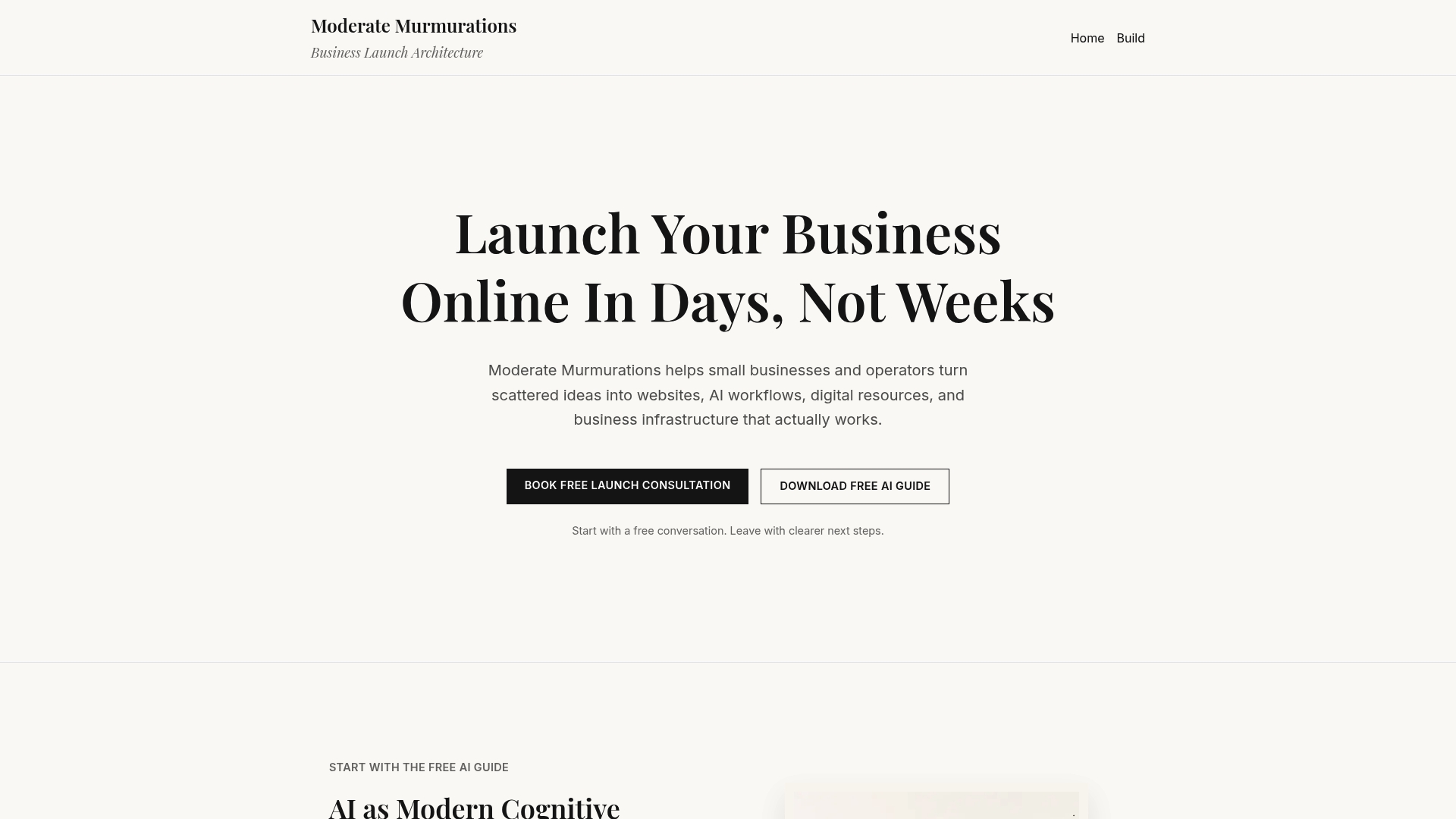
Every site we build includes clear messaging, modern design, search-friendly structure, and practical tools built for growth. We use AI workflows to move faster without cutting corners, so you get a site that looks and performs like a professional investment. Whether you are starting from scratch or rebuilding an existing site, we handle the structure, copy, and technical setup so you can focus on your work. Visit Moderatemurmurations to see how we work, or go straight to the build page to get started.
FAQ
What is a personal brand website for entrepreneurs?
A personal brand website is a platform that showcases an individual entrepreneur’s skills, personality, and work to attract clients and opportunities. It differs from a business site by centering entirely on one person’s story and unique value.
What should every entrepreneur personal brand site include?
Every strong personal brand site needs an About/Bio section, a curated portfolio, testimonials, consistent visual design, and at least one lead capture element. These elements work together to build trust and convert visitors.
How do I choose a lead magnet for my personal brand site?
Choose a lead magnet that solves one specific problem your audience faces right now. Relevance and instant delivery after opt-in drive conversions more than format or production quality.
How long does it take to build a personal brand website?
A focused personal brand site with clear copy, a curated portfolio, and a lead magnet can be built and launched in days, not months, especially with a defined template and pre-written content.
Do I need a custom domain for my personal brand site?
Yes. YourName.com is the standard for personal brand sites. A custom domain signals professionalism, improves search visibility, and makes you easier to find and remember.