How to Build Digital Systems for Your Solo Business
How to Build Digital Systems for Your Solo Business

Building digital systems for a solo business means creating documented, repeatable, and automatable workflows that let one person run a business as efficiently as a small team. The industry term for this is a solopreneur operating system: a structured set of processes covering everything from content creation to client delivery. Solo entrepreneurs who build these systems early gain real leverage. They spend less time on repetitive tasks and more time on work that actually grows their business. This guide covers the five core system categories, a step-by-step build process, the right AI tools for 2026, and how to keep everything running without burning out.
What core digital systems does a solo entrepreneur need to build first?
A complete solo business operating system covers five areas. Each one handles a distinct part of how your business runs. You do not need all five fully built on day one. The goal is a minimum viable version of each, then you improve over time.
The five core modules are:
- SEO and content system. This covers your blog, keyword research process, and publishing schedule. It feeds organic traffic to your business without paid ads.
- Growth and acquisition system. This is how you attract and convert leads. It includes your email list, lead magnet, landing pages, and follow-up sequences.
- Operations and delivery system. This covers how you onboard clients, deliver your service, and collect payment. Documented steps here reduce errors and save hours each week.
- Automation system. This connects your tools and handles repetitive tasks automatically. Think form submissions that trigger emails, or new client data that populates a project tracker.
- Publishing and digital presence. This is your website, social profiles, and any digital products. It is the public face of your business and the foundation of your online credibility.
Documented SOPs are what separate a real business from a collection of tasks. Without written processes, every task lives only in your head. That makes delegation and automation nearly impossible.
Pro Tip: Start with your operations and delivery system first. It directly affects client experience and revenue. Get that documented before you build anything else.
The most common mistake solo founders make is trying to build all five modules at once. Pick the one that causes you the most friction right now. Build a simple, working version. Then move to the next.
How to build digital systems step by step without overbuilding
A methodical approach prevents the two biggest traps: tool inflation and premature complexity. Here is a proven sequence that works for solo entrepreneurs at any stage.
-
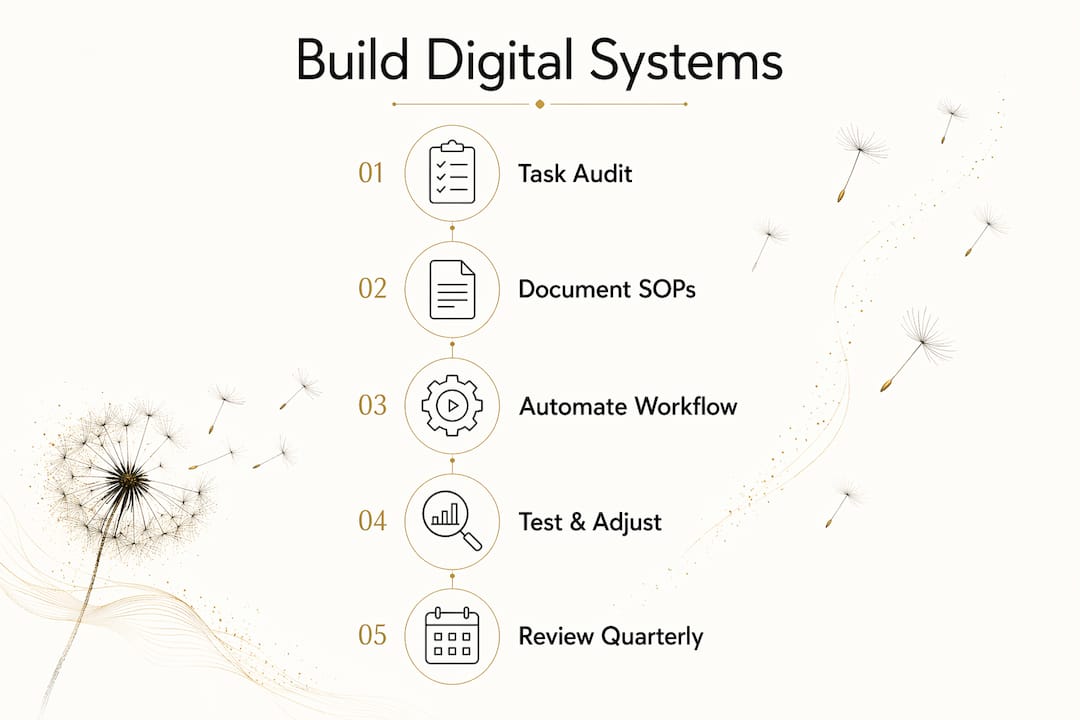
Run a 14-day task audit. Log every task you do for two weeks. Note how long each one takes. Research shows that 60–80% of daily activities for solo founders are rule-based and eligible for automation. That number is almost always surprising. Most founders think their work is more complex than it is.
-
Tag tasks by type. After your audit, label each task as “automate,” “document,” or “eliminate.” Tasks that repeat more than twice a week are your first automation targets.
-
Apply the “write the checklist” rule. The rule is simple: after you perform any task twice, write a standard operating procedure for it. This turns routine work into a documented asset you can hand off or automate later.
-
Install one new system per week. A 30-day core architecture build means four systems in place by the end of the first month. Do not rush. One working system beats three half-built ones.
-
Set a monthly tool budget cap. Keep your full tech stack under $200 per month. Most solo founders exceed this without realizing it. Audit your subscriptions now and cancel anything you have not used in 30 days.
-
Measure automation progress at 90 days. A fully mature operating system typically takes 3–6 months to reach 40% or more automation of weekly tasks. That is the benchmark. If you are below it at 90 days, identify which tasks still need a documented process.
Pro Tip: Do not build systems for a team you do not have yet. Solo founders often waste hundreds of hours engineering complex workflows for future employees. Build for today’s reality, then scale the system when the need is real.
The goal of this phase is not perfection. It is a working foundation. A simple automation that saves you 30 minutes a day is worth more than an elaborate system you never finish.

Which AI tools and automation platforms support solo entrepreneurs best?
The right AI stack replaces a traditional back office without the payroll. A complete solo tech stack now runs between $3,000 and $12,000 annually, compared to substantially higher legacy staffing costs. That gap is the core economic argument for building with AI from day one.
The optimal setup runs on five layers:
| Layer | Function | Example category |
|---|---|---|
| Coding agent | Builds and maintains technical tools | AI-assisted development platforms |
| Writing model | Drafts copy, emails, and content | Large language model tools |
| AI team platform | Manages multi-step AI workflows | Agent orchestration platforms |
| Automation runner | Connects apps and triggers actions | No-code workflow automation tools |
| Publishing surface | Delivers content and products online | Website and CMS platforms |
This five-layer stack replaces a traditional four-person back office with AI-powered workflows at under $200 per month. Each layer handles a specific function. The key is picking one well-integrated tool per layer rather than stacking multiple disconnected options.
The practical benefits break down like this:
- A writing model handles first drafts, email sequences, and social content in minutes instead of hours.
- An automation runner connects your form submissions, CRM, email platform, and calendar without manual data entry.
- A publishing surface keeps your digital workflow visible and organized for clients and prospects.
Successful solo businesses use AI agents for most execution tasks, leaving the founder to focus on strategy and judgment. That is the real shift. AI does not replace your expertise. It handles the repetitive execution so your expertise can go further.
How to maintain and optimize your solo business systems over time
Building the system is only half the work. Maintaining it is what keeps your business running without constant intervention.
The three habits that matter most are:
- Quarterly kill reviews. A recurring quarterly review is the most effective way to cancel unused tools, cut overhead, and keep your stack lean. Schedule it as a calendar event. Treat it like a board meeting with yourself.
- Weekly operating rhythm. Set aside time each week for planning, reviewing key metrics, and updating your SOPs. Pairing AI tools with a weekly rhythm compounds productivity over time. The discipline of the rhythm matters as much as the tools themselves.
- Data dashboard tracking. Monitor traffic, conversions, and revenue in one place. You cannot improve what you do not measure. A simple dashboard built in a spreadsheet or a lightweight analytics tool works fine at the solo stage.
When it comes to hiring, the data is clear. Solo founders typically bring on their first team member around 399 days after incorporation, and most start with fractional contractors rather than full-time hires. A full-time hire at $100,000 or more per year can consume 50% of gross revenue at the $200,000 annual recurring revenue stage. That makes early hiring genuinely risky. Build your systems first. Let automation carry the load until the revenue clearly justifies a hire.
Pro Tip: Review your SOPs every quarter alongside your tool audit. Business needs change, and a process that made sense six months ago may now create unnecessary steps. Keep your documentation current or it stops being useful.
Automation handles the repeatable work. Your judgment handles the exceptions. The goal is a business where the systems run the routine and you run the strategy.
Key takeaways
A solo business operating system reaches 40% or more automation within 3–6 months when built with documented SOPs, a lean AI stack, and a consistent weekly rhythm.
| Point | Details |
|---|---|
| Start with a task audit | Log 14 days of work to identify which tasks are rule-based and ready to automate. |
| Document before you automate | Write a standard operating procedure after performing any task twice. |
| Keep the stack lean | Cap your monthly tool spend at $200 and run quarterly reviews to cut unused subscriptions. |
| Use the five-layer AI model | Cover coding, writing, team workflows, automation, and publishing with one tool per layer. |
| Build for now, not later | Avoid engineering systems for a future team. Iterate with your current reality and scale when needed. |
What I have learned from watching solo founders build their systems
The founders who build the most effective systems share one trait: they resist the urge to make things complicated. I have seen solo entrepreneurs spend three months building a client portal with custom integrations before they had a single paying client. The system was impressive. The business was not moving.
The psychological pull toward complexity is real. Building systems feels like progress. And it is, up to a point. The problem is that most solo founders cross that point without noticing. They add another tool, another integration, another automation layer. Then they spend more time maintaining the system than serving clients.
The founders who get it right treat their automation setup like a garden, not a machine. They prune it regularly. They remove what stopped growing. They add only what has a clear purpose.
AI has genuinely changed the math here. A solo founder in 2026 can do work that would have required a team of four just a few years ago. But the leverage only materializes if the system is simple enough to actually use. A five-tool stack you use every day beats a fifteen-tool stack you manage on weekends.
My honest advice: start with the one system that would save you the most time this week. Build it. Use it. Document it. Then build the next one. That is how a real operating system grows.
— Christopher
How Moderatemurmurations helps you build your digital foundation
Moderatemurmurations builds fast, clean websites, AI workflows, and digital infrastructure for solo entrepreneurs and small business owners who want a professional online presence without the complexity.
If you are ready to move from scattered tools to a working system, Moderatemurmurations can help you launch your business online with clear structure from day one. The team handles website setup, brand copy, SEO foundations, and the digital systems that keep your business running. You can also explore the full range of website and AI workflow services to find the right fit for where your business is right now. The goal is always the same: a clean, working foundation you can build on.
FAQ
What does it mean to build digital systems for a solo business?
Building digital systems for a solo business means creating documented, repeatable workflows that handle routine tasks automatically. These systems cover areas like content, client delivery, email automation, and online presence.
How long does it take to automate a solo business?
A fully mature solo business operating system typically takes 3–6 months of consistent weekly work to reach 40% or more automation of weekly tasks.
What is the “write the checklist” rule?
The rule states that after performing any task twice, you should write a standard operating procedure for it. This turns routine work into a documented asset you can automate or delegate.
How much should a solo founder spend on tools each month?
Keeping your full tech stack under $200 per month is the recommended cap for lean solo operations. A quarterly review helps you cancel unused subscriptions and stay within budget.
When should a solo founder hire their first team member?
Solo founders typically bring on their first hire around 399 days after incorporation, often starting with fractional contractors. Building strong digital systems first reduces the urgency and cost of early hiring.